Quick answer
You do not always need to buy your own ISBN to self-publish. Amazon KDP assigns an ASIN to Kindle ebooks and offers a free ISBN for paperback and hardcover editions. Buying your own ISBN makes more sense when you want your own publishing imprint attached to the book, plan to distribute the same edition through more than one publishing service, or are building a long-term catalogue across several formats.
In the United States, one ISBN currently costs $125 from Bowker, while a block of 10 costs $295. Because paperback, hardcover, and any ebook edition that uses an ISBN are treated as separate products, buying a block is usually better value than purchasing numbers one at a time.
This guide explains what an ISBN actually does, when a free one is enough, what owning one changes, and how the number connects to the barcode and cover wrapped around your book.
What Is an ISBN, in Plain English?
An ISBN, or International Standard Book Number, is a 13-digit product identifier used for books. Retailers, wholesalers, libraries, distributors, and publishing platforms use it to identify a specific title, edition, format, and publisher.
Think of it as your book’s product identity, not as copyright protection. An ISBN does not prove that you wrote the book, register your copyright, or stop someone from copying your work. It helps the publishing supply chain list, order, sell, and track the correct version of your book.
One rule causes a lot of confusion for first-time self-publishers: different formats require different ISBNs whenever an ISBN is assigned.
Your paperback and hardcover need separate ISBNs. An ebook may not need one on every platform, but if you assign an ISBN to the ebook, it cannot share the paperback or hardcover number. A substantially revised edition also requires a new ISBN. A simple cover refresh, price change, or correction of minor typographical errors usually does not.
Do You Actually Need an ISBN?
It depends on how and where you plan to publish.
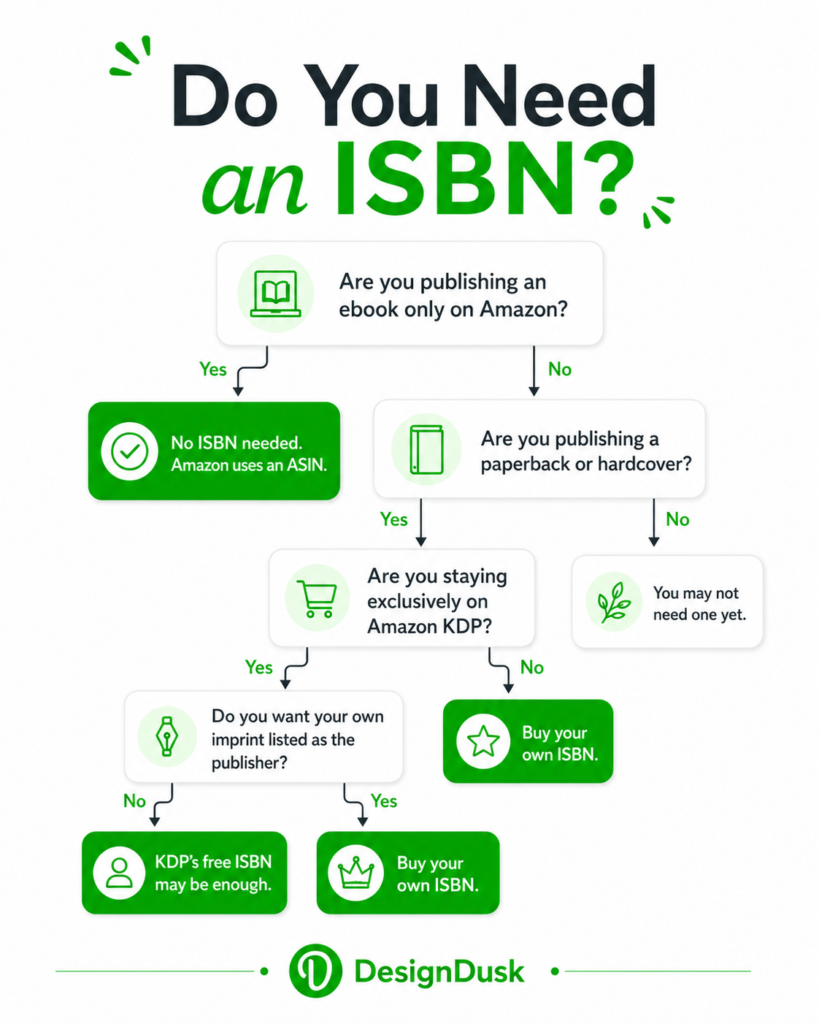
You may not need to buy your own ISBN if:
- You are publishing a Kindle ebook only on Amazon, which uses an ASIN instead.
- You are comfortable using KDP’s free ISBN for a paperback or hardcover.
- You are testing your first book and do not yet need your own publishing imprint.
- You have no immediate plan to publish the same print edition through another service.
You should seriously consider owning your ISBNs if:
- You want your own business name or publishing imprint listed with the book.
- You plan to publish print editions through services such as KDP and IngramSpark.
- You want to build a consistent catalogue across several books and formats.
- You expect to approach bookstores, libraries, schools, or other organisations.
Owning an ISBN does not guarantee that a bookstore or library will stock your book. Buyers may also consider distribution, wholesale discount, returnability, demand, and print quality. However, owning the number gives you control over the associated imprint and makes it easier to maintain consistent publishing information across your catalogue.
What Does an ISBN Cost in the United States in 2026?
In the United States, Bowker is the official ISBN agency. ISBNs are purchased through MyIdentifiers, and the current prices are:
| Package | Price in USD | Cost per ISBN |
|---|---|---|
| 1 ISBN | $125 | $125 |
| 10 ISBNs | $295 | $29.50 |
| 100 ISBNs | $575 | $5.75 |
Prices and packages can change, so check MyIdentifiers before purchasing.
The pricing shows why buying one ISBN at a time is usually poor value. A single number costs $125, while 10 cost $295. A book released as a paperback, hardcover, and ISBN-assigned ebook can use three numbers immediately. ISBNs do not expire, so unused numbers can remain in your account until your next book is ready.
At DesignDusk, we regularly work with authors who begin with an ebook and paperback, then decide to add a hardcover or another print edition later. That is why we ask which formats an author is planning before the print covers are prepared. Thinking about the full release at the beginning can prevent rushed barcode changes and unnecessary one-at-a-time ISBN purchases later.
The Free KDP ISBN: What Is the Catch?
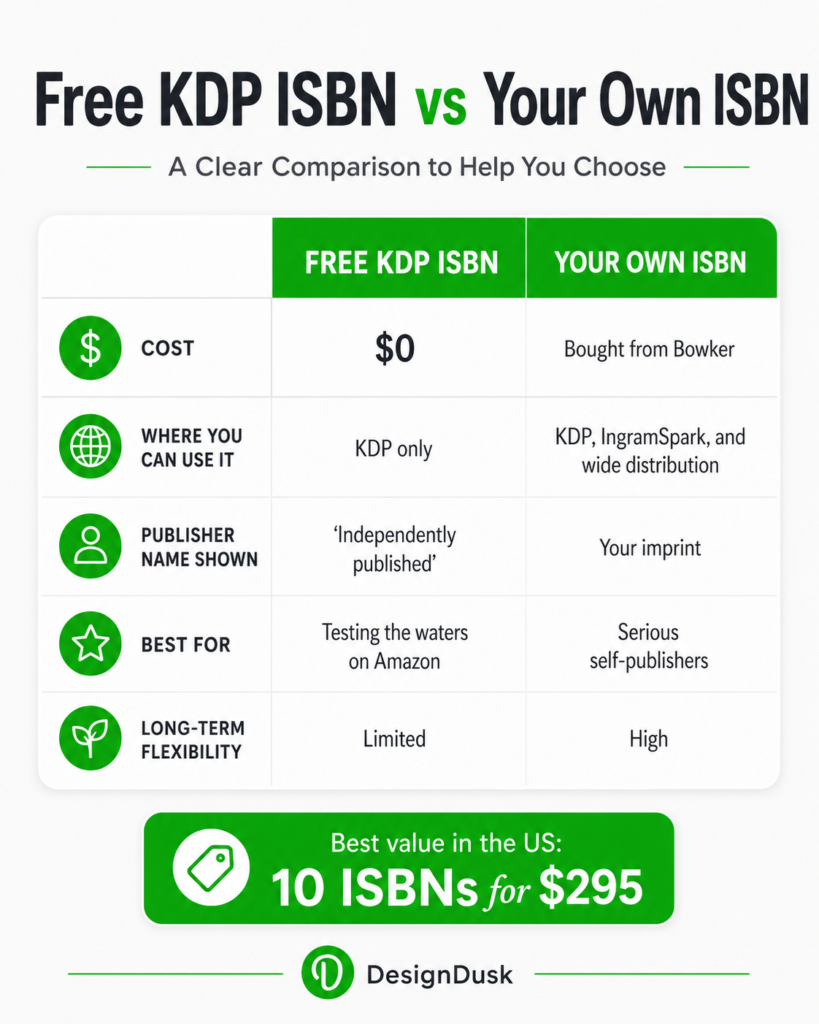
Amazon KDP’s free ISBN is genuinely free. It is available for paperback and hardcover books, and there is no hidden charge. The limitations are about control and flexibility rather than money.
1The imprint appears as “Independently published”
When you use KDP’s free ISBN, the imprint displayed for the book is “Independently published.” You cannot replace it with your own publishing company or imprint name.
2The ISBN can only be used on KDP
A free KDP ISBN cannot be taken to IngramSpark or another publishing service. If you later decide to publish that format elsewhere, you will need a different ISBN for the new version.
3You have less control over your publishing identity
For an author testing one book, this may not matter. For an author building a series, an imprint, or a wider publishing business, owning the ISBNs creates a more consistent catalogue and gives you direct control over the registered metadata.
The practical rule: use the free KDP ISBN when you are publishing only through KDP and want the easiest possible start. Buy your own ISBNs when your imprint, wider distribution, or long-term catalogue matters to you.
How ISBNs, Barcodes, and Your Cover Fit Together
This is where ISBNs stop being paperwork and become part of the physical book.
For a print edition, the ISBN is normally encoded in an EAN-13 barcode placed on the back cover. A separate five-digit price code may also appear beside it. Retailers and distributors scan the barcode to identify the exact edition being sold.
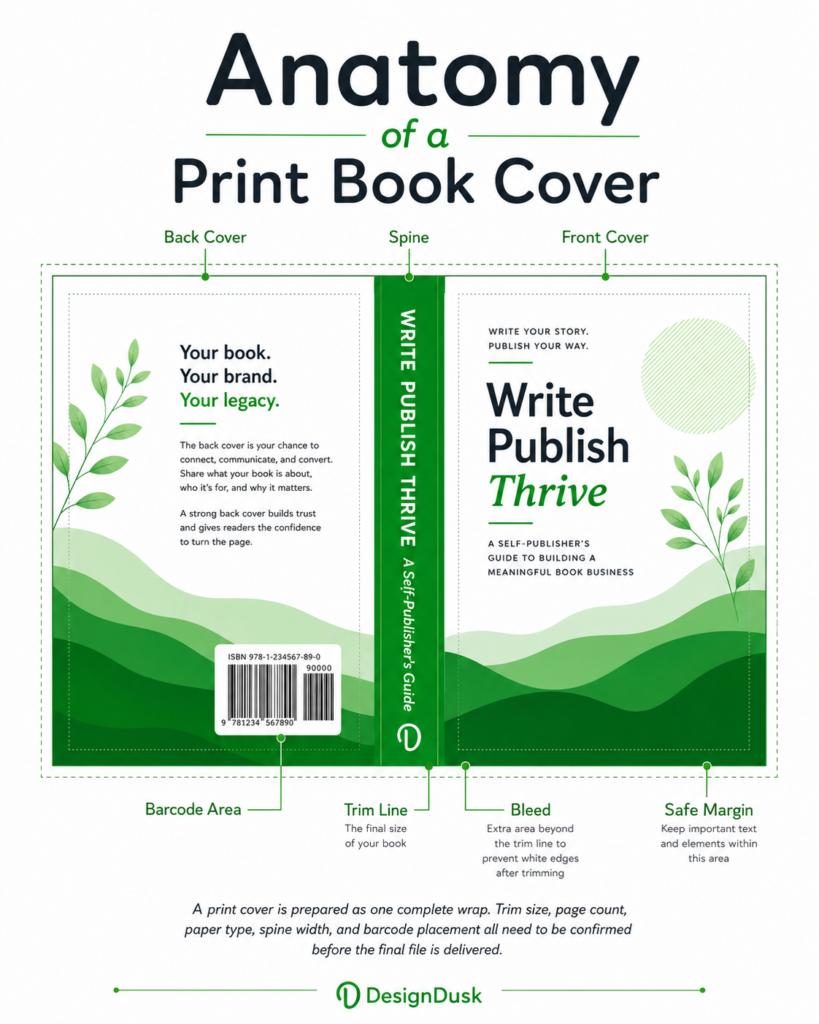
Here are the practical cover-design points authors need to know:
- You do not normally need to pay separately for a barcode. KDP can place a properly formatted barcode on the back cover at no additional cost when you upload a cover without one.
- The barcode area must remain clear. Text, faces, logos, and important artwork should not sit where the publishing platform will place the barcode.
- The barcode must match the format. A paperback and hardcover use different ISBNs, even when they share the same front-cover artwork.
- The print wrap depends on more than the ISBN. Trim size, final page count, paper type, bleed, binding, and publishing platform all affect the dimensions of the final cover. See our book cover size & dimensions guide for the exact formulas and platform requirements.
- You can buy ISBNs before the cover is designed. The numbers do not expire. However, do not permanently assign one to a title and format until those publication details are settled.
In DesignDusk’s paperback and hardcover workflow, we ask for the trim size, final page count, paper type, publishing platform, and ISBN or barcode preference before completing the full print wrap. Paperback and hardcover files are prepared separately because their templates and spine measurements are different. When the platform will generate the barcode, we reserve a clean barcode zone; when the author supplies a finished barcode, we place it only after the title and format details are confirmed.
That small step prevents a common last-minute problem: finishing a beautiful back cover and then discovering that a white barcode box must cover part of the artwork or text.
How to Get an ISBN in the United States
- Create an account with Bowker through MyIdentifiers, the official US ISBN agency.
- Choose the quantity you need. A block of 10 is usually better value for authors planning more than one format or book.
- Complete the purchase. The ISBNs are added to your account after payment.
- Assign one ISBN to each specific title, edition, and format.
- Enter the book’s metadata carefully, including its title, author name, imprint, format, publication date, description, and price.
- Make sure the information entered on KDP or another publishing platform matches the ISBN agency’s record.
- Update your metadata when relevant details change, while remembering that a major change such as a new title, substantially revised edition, or different format may require a new ISBN.
This process applies to US-based authors and publishers. Authors based outside the United States should use the official ISBN agency for their own country rather than purchasing through Bowker.
Common ISBN Mistakes Self-Publishers Make
1Buying only one ISBN without planning future formats
In the US, buying three individual ISBNs would cost $375, while a block of 10 costs $295. Plan for paperback, hardcover, ebook, audiobook, revised editions, and future books before choosing a package.
2Reusing one ISBN across different formats
A paperback, hardcover, and ISBN-assigned ebook are separate products. Reusing one number can cause metadata errors, rejection, or incorrect listings.
3Assuming a free ISBN can move between platforms
A free KDP ISBN is limited to KDP. It cannot be reused to publish through IngramSpark or another service.
4Buying a discounted ISBN from an unofficial reseller
The ISBN may identify the reseller rather than you as the publisher. Always use your official national ISBN agency when you want ownership and control of the publishing record.
5Thinking an ISBN provides copyright protection
An ISBN identifies a publication. Copyright is a separate legal matter and follows different rules and registration processes.
6Assigning the ISBN before the book details are final
An ISBN is tied to a specific title, edition, and format. Confirm your details before assigning it, particularly if the title, subtitle, format, or publisher name may still change.
7Finalising the back cover without planning the barcode area
Even when KDP generates the barcode, it still needs clear space. Reserve the barcode zone before approving the final artwork.
Frequently Asked Questions
No. Amazon assigns an ASIN to Kindle ebooks and offers a free ISBN for paperback and hardcover editions. You need your own ISBN only when you want to use a number you control, register your own imprint, or use the same edition with another publishing service.
No. A paperback and an ebook are different product formats. If the ebook is assigned an ISBN, it needs a number different from the paperback ISBN.
Usually not. A cover redesign by itself generally does not require a new ISBN when the title, format, publisher, and content remain substantially unchanged. A new title, different format, new publisher, or significantly revised edition may require one.
No. Unused ISBNs do not expire, so you can purchase a block and assign the numbers to future books as needed.
No. The ISBN is the identifying number. The barcode is the machine-readable graphic that encodes the number on a print cover. KDP can generate and place the barcode automatically when your uploaded cover leaves the required area clear.
Bowker currently charges $125 for one ISBN, $295 for 10, and $575 for 100. For most self-publishers planning multiple formats or future books, the 10-pack offers much better value than buying numbers individually.
A free KDP ISBN is suitable for an author who wants to publish a print book only through KDP with the least expense and setup. Buying your own is usually the stronger long-term option when you want a named imprint, wider distribution, or several books and formats.
Getting your ISBN sorted usually means you are close to publication, which means it is time to finalise the cover. Choose an exclusive premade book cover that is ready to customise, or commission a custom book cover design prepared around your book’s trim size, spine, print platform, and barcode requirements. Have a question before ordering? Contact DesignDusk.