Quick answer
Under U.S. law, copyright initially belongs to the author of each protected creative element, unless a valid work-for-hire rule applies. Buying a cover normally buys files plus a licence, not the copyright itself. A copyright transfer generally requires signed writing. Read the agreement because stock art, typography and the final composition can carry different rights.
Authors ask this question at two moments: right before paying a designer, and right after a rights complaint lands in their inbox. The answer surprises people, because paying for something usually means owning it. Copyright does not work that way. Here are the seven answers that settle almost every cover deal, including an honest description of how our own licence works.
One thing before we start: we design book covers, we do not practise law. This is general information, written mostly against US law. For a live dispute or a contract with serious money behind it, pay an intellectual property lawyer for an hour.
The two covers shown below are live premades from our catalogue (1,600+ designs in stock as of November 2026). Every design is sold once, then retired. Designer-Created covers run $49.99 ebook / $99.99 with paperback; the labelled AI + Human tier runs $24.99 / $59.99.
1. Who owns a book cover by default? The person who made it
Copyright in protected original expression initially belongs to its author when the work is fixed. On a composite cover, different protected elements may have different owners or licences; a sufficiently creative selection and arrangement can carry its own protection, while a general layout or template does not. Commissioning the work changes nothing by itself. Paying for it changes nothing by itself. If your agreement never mentions copyright, the designer still owns the design you paid for, and what you hold is at best an implied licence: the vague arrangement that turns into an argument two years later when the book takes off.
2. What is work for hire, and is your cover one?
Probably not. Under US law a work is made for hire in two situations: an employee creates it within the scope of employment, or a specially commissioned work falls within a statutory category and both sides expressly agree in signed writing that it is work made for hire. A freelance cover commission without that signed wording is not work for hire, whatever the invoice says.
The other route is an assignment: a transfer of copyright ownership generally must be in writing and signed by the rights owner. Some designers sell assignments for an extra fee. Most authors never need one.
3. What a licence actually gives you
A licence is permission, scoped by its wording. The scope is where deals differ, so this is the part of any cover agreement worth reading twice.
| What you want to do | Non-exclusive licence | Exclusive licence | Full assignment |
|---|---|---|---|
| Publish ebook and print | Yes, if stated | Yes | Yes |
| Use in ads and marketing | Usually stated | Yes | Yes |
| Stop others using the design | No | Yes, within scope | Yes |
| Alter or extend the design | Only if stated | Only if stated | Yes |
| Sell merchandise | Rarely included | Only if stated | Yes |
| Register the copyright yourself | No | No | Yes |
Check five things in the wording: formats covered, exclusivity, duration, territory, and whether the licence transfers if you sell your publishing rights. A one-page licence answering those five beats a handshake and a chat log every time. Still deciding between a finished design and a commission? Our premade vs custom guide walks the trade-off.
4. What Amazon expects you to be able to prove
KDP requires publishers to hold the necessary publishing rights for uploaded content, including cover art, and may request documentation before making a book available for sale. Nobody at Amazon checks paperwork on upload day. The request arrives later, usually after an artist, stock agency or another author files a claim, and then you have days, not weeks.
So keep a rights folder per book: invoice, licence or assignment text, the designer’s contact, the delivered files. Five minutes of filing now is the whole defence later.
5. The stock images and fonts inside your cover
Most photographic covers are built from licensed stock. The designer buys it under their own account, and your right to use it flows through their licence. So ask two things: is every image licensed for commercial book use, and do planned uses such as merchandise require additional permission under that agency’s current terms.
Fonts work the same way: software licensed to the designer, but the exact permitted uses depend on the font licence; ask the designer to confirm commercial cover use. A designer who names stock sources and font licences on request has thought about your risk, and that is worth paying for.
6. AI-generated artwork changes the copyright answer
The U.S. Copyright Office says generative-AI output is protected only where a human author determined sufficient expressive elements. Human-authored selection, arrangement or modification may qualify; prompting alone does not. The practical translation: a fully AI-generated cover may be very hard to defend against a copycat, because there may be nothing registrable to defend.
This is why our catalogue labels its AI tier instead of hiding it: a buyer weighing the copyright question deserves to know what is inside the file, and the label is also why that tier costs half the designer tier.
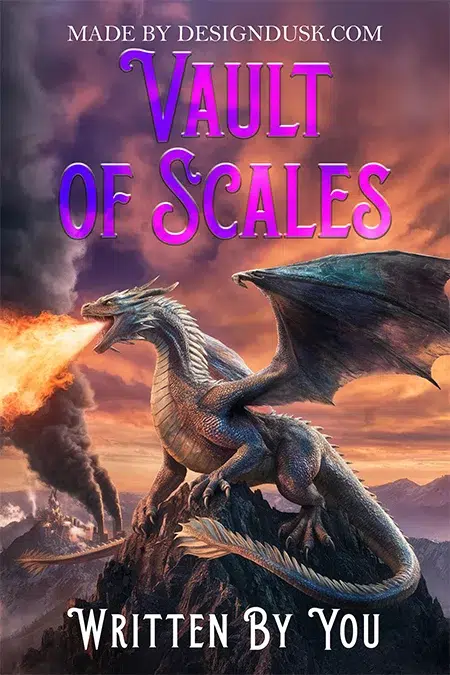
Vault of Scales
Vault of Scales sits in our AI + Human tier: AI-assisted, labelled, $24.99. The dragon imagery is AI-generated, then composited, colour-graded and typeset by a designer, so the human layer is real but the base imagery is machine output. We price and label it accordingly, and Australian readers can see how disclosure rules are heading in our Australian AI rules guide.
7. How our licence works, honestly
When you buy a premade from our shelves, here is the deal in plain words. You get the finished cover files for your book and its marketing. We keep the copyright in the design. The design is sold once and retired. The standard licence covers ebook and print use, marketing assets and print runs up to 500,000 copies; copyright and underlying third-party rights do not transfer unless a separate signed assignment says so. Custom work at $120 ebook / $250 paperback / $350 hardback through our custom design service follows the same structure unless an assignment is agreed in writing.
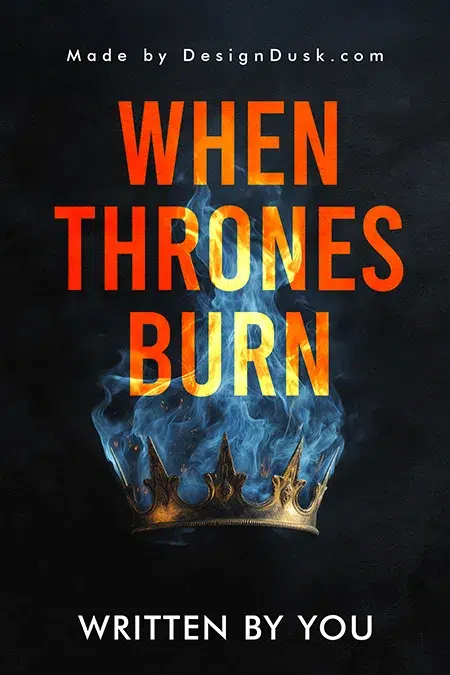
When Thrones Burn
When Thrones Burn is a Designer-Created premade at $49.99 from our epic fantasy shelf. The buyer gets the files and a licence; we keep the copyright; the listing retires on sale. That combination supplies the publishing rights most authors need without claiming a transfer of copyright.
What to print on your copyright page
Attribution depends on the contract and the rights inside the design, but it earns its line: it documents the chain of rights inside the book itself. Two wordings that work:
- Cover design by DesignDusk (designdusk.com)
- Cover art © 2026 DesignDusk, used under licence
Use the second form when your designer keeps copyright, which, as covered above, is the normal case.
FAQ
— Every cover in our catalogue is sold once, then retired: 1,600+ designs in stock across the fantasy shelf and beyond, from $24.99.
Yes. The artwork, photography and overall design of a cover are protected as an artistic work from the moment of creation. Book titles and typeface as typeface are not protected by U.S. copyright, and general layout alone is not registrable. Copyright may protect the specific artwork and a sufficiently creative selection or arrangement of content.
Almost never. The standard deal in self-publishing is a flat fee for a licence or, less often, an assignment, with no ongoing payments regardless of how the book sells. Royalties only exist if a contract creates them, which is rare outside trad-publishing illustration deals. If your agreement is silent, no royalties are owed.
No. Buying a cover buys you the deliverables plus whatever rights the agreement grants, which is normally a licence. Copyright stays with the designer unless a signed written assignment or a valid work-for-hire agreement says otherwise. For publishing purposes a well-scoped licence covering ebook, print and marketing does everything ownership would.
You need enough rights to reproduce the cover on ebook and print editions and in marketing, and KDP may ask for documentation before a book is made available. A written licence from the designer, kept with your invoice and files, satisfies this. Full copyright ownership is not required.