Quick answer
There is no single test that proves a premade cover is human made. But you can get much stronger evidence by checking how the shop labels AI work, whether the price makes sense for the process, where the source imagery comes from, what working-file or licensing information the seller can show, and whether the artwork or metadata raises additional flags. The goal is not to trust a “NO AI” badge. It is to see whether the claim holds up when you ask questions.
Search “premade book covers no AI” and you get Etsy listings with NO AI shouting from the title, forum threads, and very little guidance on how to test any of it. The claim is free to make. Nobody audits it.
We are in an odd position to write this guide: we sell both kinds. Our catalogue labels 63 designs as AI-assisted and prices them at half the designer rate, while the other 1,704 are built by designers using traditional design workflows. Because we publish the label, we can show you what checkable transparency looks like, and what to ask from any shop that claims its covers are made without AI.
As of this update, 1,585 covers are in stock. Designer-created premades run $49.99 ebook / $99.99 +paperback / $149.99 +hardback. The 63 AI-assisted designs are labelled and run $24.99 / $59.99 / $99.99. Every cover sells once, then retires.
Why “no AI” claims are hard to check
The economics make disclosure important. A photoreal fantasy scene can now be generated in minutes, while a traditional composite may involve sourcing imagery, checking licences, masking, retouching, colour grading, typography and hours of design work.
A premade listing usually gives you a JPEG and a promise. If the seller does not explain how the artwork was made, the buyer has very little information beyond the final image.
The good news: you can still look for evidence. None of the seven checks below need design training. Run them together rather than treating any single one as a verdict; most questionable listings start raising flags within the first few checks.
Check 1: does the shop label anything as AI?
This is the counterintuitive one.
A catalogue with zero AI labels means one of two things: the shop uses none, or the shop does not disclose any. From the outside, those can look identical.
A shop that publicly separates AI-assisted work from designer-created work has at least built something useful: a visible disclosure policy with different creation methods attached to specific products.
That does not independently prove every unlabelled cover is human made. But it gives you something concrete to evaluate instead of a generic “NO AI” promise.
Here is what a labelled pair looks like on our romance shelf, same genre, same shelf, different tier:
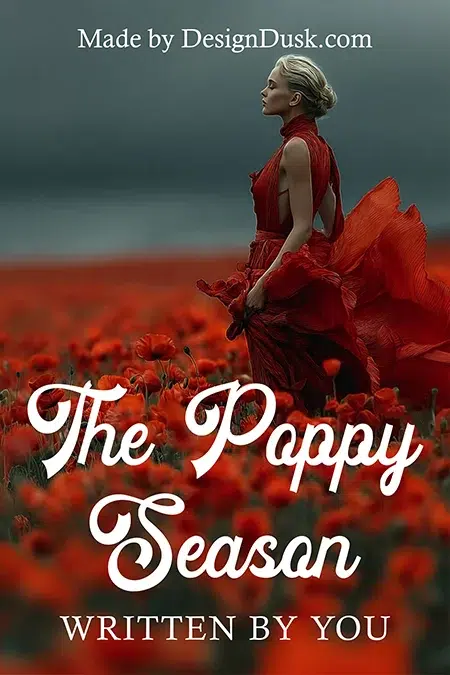
The Poppy Season
The Poppy Season is AI-assisted, labelled, $24.99. The woman, the poppy field and the stormy sky use generated imagery; our designer set the crop, the flowing script title and the print files. The label and price tell you that AI was part of the image-making process.
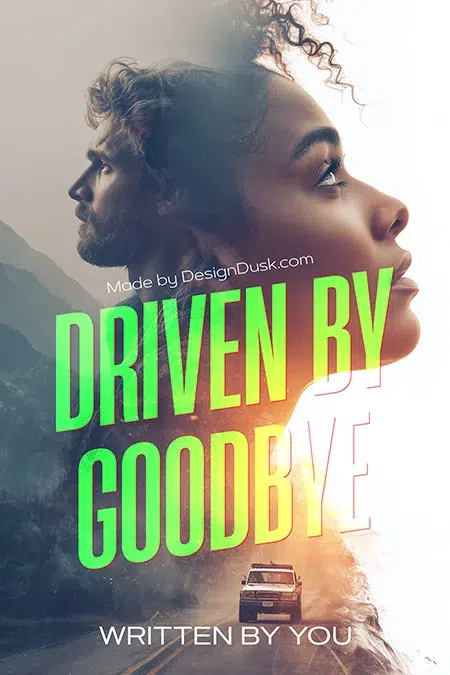
Driven by Goodbye
Driven by Goodbye is designer-created, $49.99. Two portraits and a mountain-road photograph are masked and blended into a single double exposure, colour-graded warm green and gold, with title type keyed to the light. The higher tier reflects the traditional compositing workflow behind the finished image.
Check 2: does the price make sense for the claimed process?
Price cannot prove whether a cover is human made.
A designer can use original artwork, previously licensed assets, public-domain material or free commercial fonts. Designers also work in different markets, charge different rates and occasionally discount old inventory.
So do not use a low price as a verdict.
Use it as a question.
A traditional premade often involves licensed stock photography or illustration, fonts, compositing, masking, retouching, colour grading and design time. Our cost guide breaks down what those inputs can involve.
Use our two tiers as one calibration point: $24.99 is where we price AI imagery finished by a designer, while our designer-created premades begin at $49.99.
If you find a $10 cover claiming to contain original hand illustration and several hours of custom compositing, you do not need to accuse the seller of using AI. You should simply ask how the work was produced.
Price is a screening signal. It is not proof.
Check 3: reverse image search the artwork
Save the listing image and run it through Google Lens and TinEye.
There are a few common outcomes:
- You find the base photo or illustration on a stock agency. That can be a positive sign of a traditional composite. It shows you a plausible source for part of the artwork, although it does not by itself prove that the seller licensed that asset correctly.
- You find the exact finished cover artwork on other covers or print-on-demand products. That is a much bigger problem. If the seller is promising a one-of-a-kind premade, the same final design should not be appearing elsewhere.
- You find the same underlying stock photograph on another book cover. That is not automatically a problem. Stock imagery is commonly licensed non-exclusively and can appear in multiple designs.
- You find nothing. Inconclusive. Reverse-image search does not index every photograph, illustration or stock library, and heavily composited artwork may no longer resemble its source closely enough to match.
That last point matters.
A photorealistic image with no search result is not proof that AI made it. Treat it as a reason to continue with the next checks, especially if other things about the listing already feel unclear.
Check 4: ask what proof comes with the file
One message before you pay can tell you a lot:
“Can you tell me how the artwork was created, which stock agencies the imagery came from, and whether you can show me the working file or layers?”
A traditional composite normally has a working file containing things such as masks, adjustment layers, placed artwork and live typography. A seller may also be able to identify the stock agency used for the source material.
Do not expect every designer to hand over the PSD. Source files may contain licensed stock, reusable assets or parts of the designer’s working process that are not included in the sale.
Instead, ask whether they can show a screenshot of the layers or otherwise explain the construction of the cover.
Also be careful with stock licensing language.
There is no universal rule saying every standard stock licence is “non-transferable.” Different agencies handle client work differently. What matters is whether the seller can identify the source and explain how the licence covers the final design supplied to you.
An honest AI seller should be able to answer the creation-method question just as clearly.
The strongest signal is consistency: does the explanation match the product page, the price, the artwork and the licence wording?
Check 5: read the artwork like a proofreader
Generated imagery has improved quickly, so visual artefacts are less reliable than they were a few years ago.
They are still worth checking.
Zoom in on:
- Hands, fingers and where they grip objects.
- Lettering inside the artwork: signage, book spines, jewellery engraving or clothing.
- Hardware logic: clasps that fasten nothing, straps that disappear, jewellery that melts into skin, or weapons that connect strangely to hands.
- Repeating texture in foliage, crowds, scales, windows or clouds.
- Small background objects whose geometry stops making sense when enlarged.
- Areas where hair, fabric, fingers or accessories merge unnaturally.
None of these proves AI on its own.
Human artists make mistakes. Stock composites can contain strange details. Modern generators can also produce perfectly convincing hands and readable text.
The useful thing is the pattern.
One odd finger means very little. Several visual anomalies combined with an unclear creation method, no source information and vague licensing are more meaningful.
Check 6: read the licence wording
Listings sometimes reveal more about their process in the legal text than in the marketing copy.
Traditional composite shops may mention stock imagery, commercial licences, fonts or third-party assets because those are part of the workflow.
AI-based shops may talk about generated artwork, AI-assisted imagery, platform-generated assets or commercial-use rights provided under an AI service’s terms.
But wording alone is not proof.
The word “generated” can describe AI artwork, but it can also appear in completely ordinary legal or production language. Likewise, a sentence such as “all rights included” tells you very little unless the seller explains what rights they actually mean.
Look for specificity instead:
- Was AI involved in creating the image?
- Is stock artwork involved?
- Who holds the underlying stock licence?
- What rights do you receive in the final cover?
- Is the cover sold exclusively?
- Are fonts or other third-party assets subject to separate licence terms?
Specific answers are more useful than impressive-sounding rights language.
Check 7: check the file’s metadata
Some newer image systems use Content Credentials, including C2PA provenance metadata, to record information about where a file came from or how it was edited.
Free Content Credentials inspectors can read that information when it is available.
But there is an important rule:
The presence of Content Credentials does not automatically prove AI.
C2PA can also document photographs captured by supported cameras, editing history and other non-AI creative workflows.
You need to inspect what the credential actually says.
If the provenance record specifically says that generative AI was used, that is useful evidence that AI was involved.
If there is no credential, you have learned almost nothing.
Metadata can be removed or lost through re-exporting, screenshots, uploads, compression and other processing. Some provenance systems can also use methods beyond ordinary embedded metadata, so the technology continues to evolve.
Treat provenance as a one-way clue:
A credential that specifically records generative AI can confirm AI involvement. Missing metadata does not confirm human authorship.
What to do with the results
Do not expect one check to give you a courtroom-level verdict.
The useful question is whether several independent signals tell the same story.
If the seller clearly explains the creation method, the source imagery makes sense, the working-file information matches that explanation, the licence terms are specific, the artwork raises no obvious concerns and any available provenance data agrees, you have much stronger grounds for confidence.
If several checks fail, you have two honest options: pay a fair human-design price somewhere that can explain its process, or knowingly buy AI-assisted work at an AI-assisted price.
Both are legitimate choices.
The outcome worth avoiding is paying for one creation method while unknowingly receiving another.
Browse the romance shelf to see the label system running across a whole category, and if nothing premade fits, custom design runs $120 to $350 with the process visible from concept through to print files.
Still deciding between routes? Start with premade versus custom.
FAQ
— Every DesignDusk cover states its tier on the product page: designer-created from $49.99, AI-assisted and labelled from $24.99. 1,585 in stock today, each sold once. Start at the romance shelf.
There is no single reliable test. Start with a reverse-image search, inspect small details in the artwork, ask the seller how the cover was created and where any stock imagery came from, and check available Content Credentials or provenance metadata. You are looking for several independent signals that agree with each other rather than one supposed AI detector.
Some are. AI-generated and AI-assisted imagery has become part of the premade-cover market because it can make image production faster and cheaper. The issue is not whether those covers should exist. It is whether buyers know what they are purchasing. Our catalogue labels 63 of 1,767 designs as AI-assisted at $24.99, while the remaining designs are sold under our designer-created tier beginning at $49.99.
Prices vary widely depending on the designer, artwork, licensing, genre and whether you need an ebook cover or a full print wrap. As a broad guide, labelled AI-assisted premades commonly sit toward the lower end of the market, while designer-built premades often start around $40 to $50 and can run to $200 or more. Premium illustration and more complex artwork can cost considerably more. Do not treat price as proof of how a cover was made. Use an unusually low or unusually high price as a reason to ask what work and rights are actually included.
Yes. Amazon KDP currently allows AI-generated cover imagery, but requires publishers to disclose AI-generated content when publishing or republishing a book. KDP specifically includes cover images and artwork in that requirement. Amazon distinguishes AI-generated content from AI-assisted content. If an AI tool created the actual image, Amazon considers it AI-generated even if a designer substantially edited the image afterward. AI-assisted work, where a person created the content and AI was only used to edit, refine, error-check or otherwise assist it, does not need to be disclosed under KDP’s current policy. That distinction is another reason to know exactly how your cover was made before you upload it.