
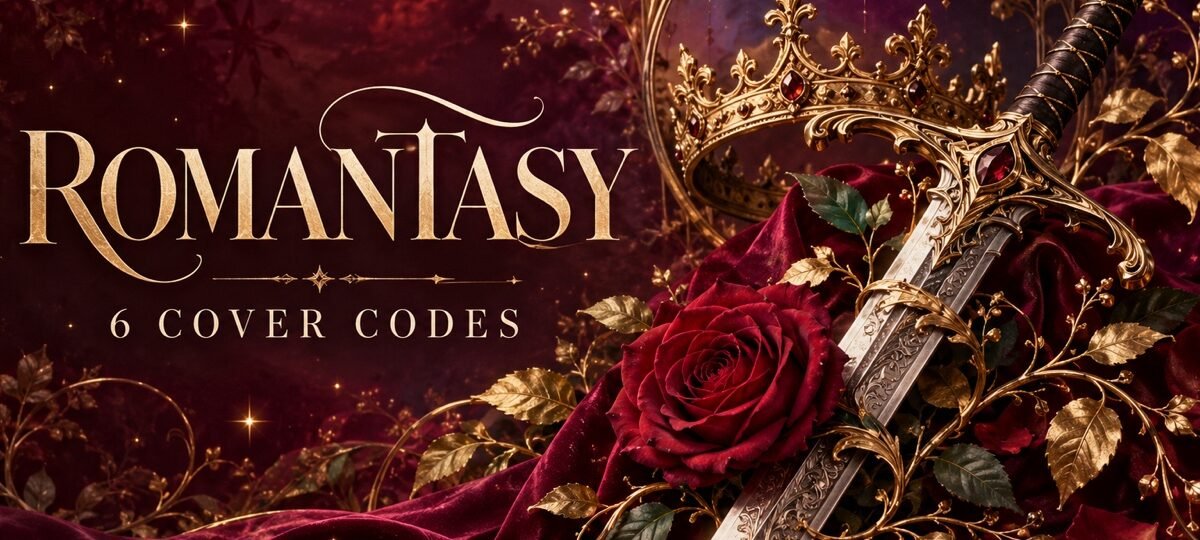
Quick answer
A romantasy cover keeps fantasy’s worldbuilding signals (crowns, armour, jewel palettes, ornamented serif type) and adds romance’s charge: two figures in tension, a longing pose, or one soft romantic object inside the fantasy frame. If the cover could sit on an epic fantasy shelf unchanged, the romance half is missing.
Romantasy went from a word almost nobody searched in 2021 to one of the fastest-rising genre terms in publishing, and the covers built the brand as much as the books did. We have already written a full guide to the fantasy side of the equation in our fantasy book cover design guide, which walks eight fantasy subgenres. This article does the other half: the romance codes, the part most crossover covers get wrong. Each code below is shown on a real cover from our shelves.
Every example here is in stock on our fantasy and romance shelves (245 and 280 covers respectively as of this update). Each design is sold once, then retired. Designer-created premades are $49.99 for the ebook cover; the labelled AI-assisted tier starts at $24.99.
1. Two figures, one charge
Fantasy covers are comfortable with a lone hero. Romantasy is not. The fastest way to signal the genre is two figures whose body language carries the relationship: guarded closeness, a protective stance, a touch that has clearly not been discussed yet. The reader should be able to guess the trope from the pose.
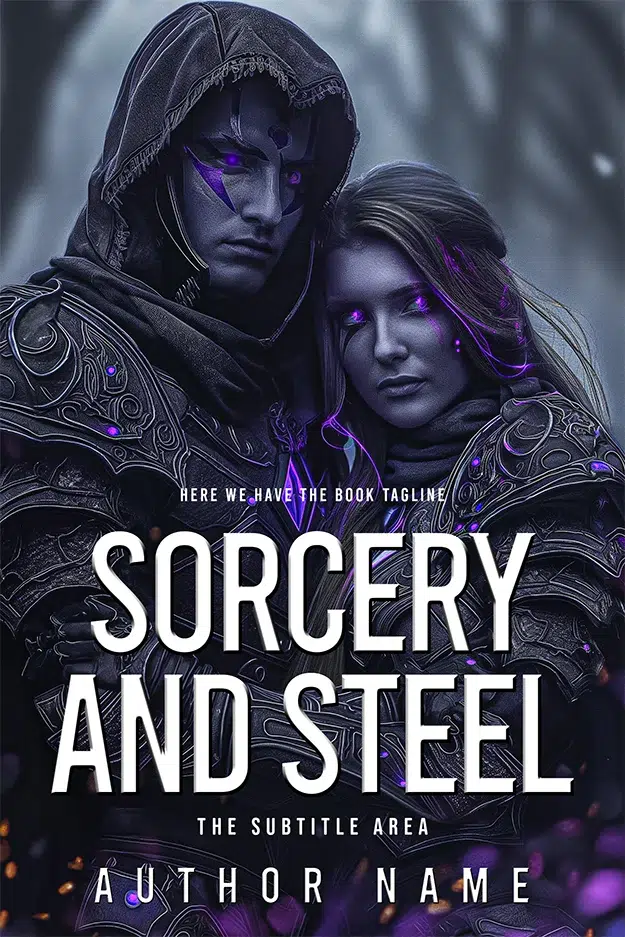
Sorcery and Steel
Sorcery and Steel is the enemies-to-allies pose done properly: his arm is around her, her head rests against him, and both wear full armour, so the closeness reads as earned rather than decorative. The violet glow on eyes and gems does the magic-system work while the embrace does the romance work. One frame, both genres.
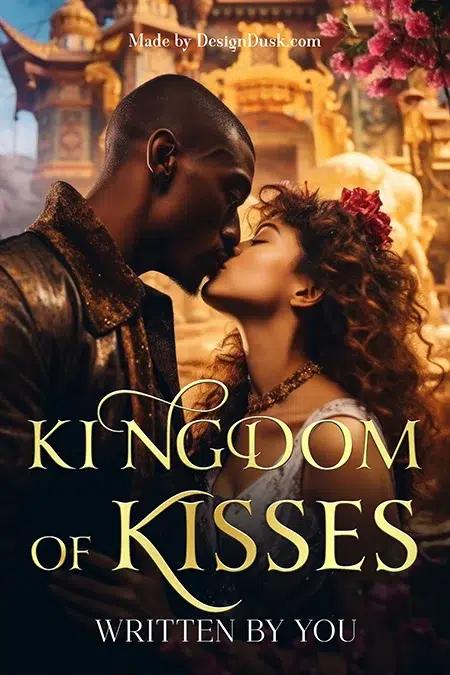
Kingdom of Kisses
Kingdom of Kisses sits at the far romance end of the same code: an actual kiss, warm gold light, a palace softened to a glow behind the couple. Nothing here is subtle, and that is the point. A reader who wants the slow burn picks the armoured pair; a reader who wants the payoff picks this.
The spacing between the two examples above is the dial you are setting. The more restrained the touch, the earlier in the relationship your cover promises to start.
2. The single figure styled for longing
Plenty of romantasy leads never share the frame with their love interest. The code still works with one figure if the styling does the emotional work: wind in the hair and the dress, a turned head, open space the figure is looking into. Fantasy gives you the costume; romance dictates the mood.
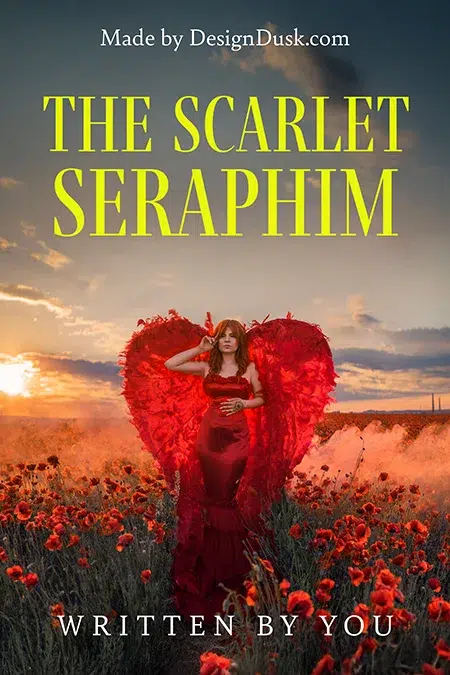
The Scarlet Seraphim
The Scarlet Seraphim is a single figure carrying a whole relationship’s worth of yearning. The red wings and gown flood the frame with the romance colour while the poppy field and sunset keep the setting otherworldly. The chartreuse title is the one non-romantic note, and it stops the cover tipping into softness.
3. One romance object inside the fantasy frame
The most economical romantasy move: build a straight fantasy cover, then place a single unmistakably romantic object in it. A rose in an ice queen’s hand. A ribbon on a sword hilt. The object works because it is out of place; the reader registers the tension instantly.
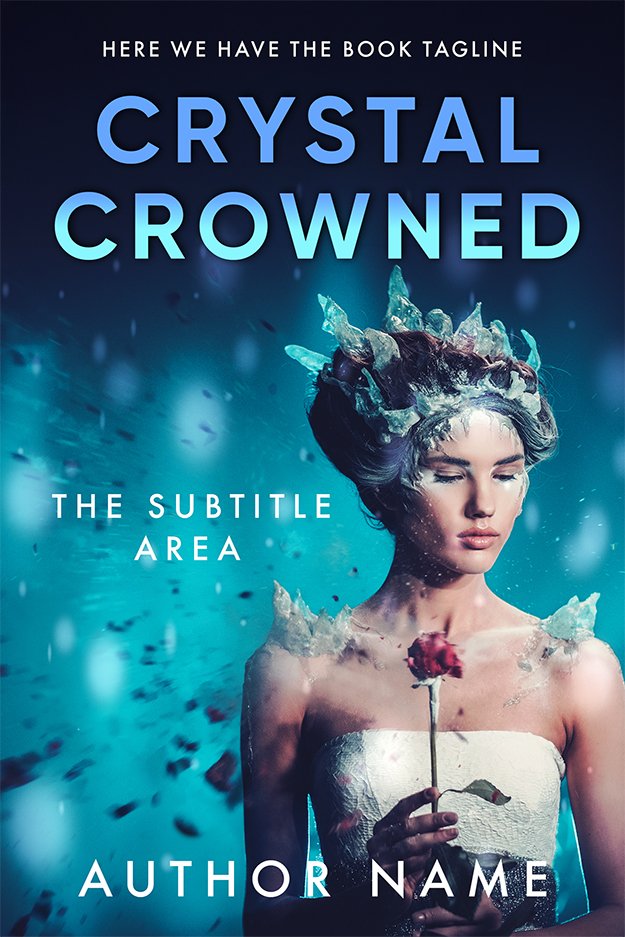
Crystal Crowned
Crystal Crowned would be a clean ice-fae fantasy cover without the rose. With it, the whole story changes: something warm has entered a frozen court and the cover tells you it will not leave undamaged. One object converts the genre. This is the cheapest, most reliable romantasy signal there is.
4. Palettes: jewel tones, night skies, one warm intrusion
Romantasy palettes borrow fantasy’s jewel depth (emerald, sapphire, amethyst) and romance’s saturation. Three combinations dominate the current shelf: a split warm/cold frame that maps the couple onto colour temperature, a night-sky field with metallic type, and a monochrome frame with a single warm intrusion like the rose above. What you should avoid is the muted, desaturated palette of literary fantasy; romantasy readers read grey as grimdark.
Cosmic Queen
Cosmic Queen shows the night-jewel palette carrying romance without a couple anywhere in sight. The crowned silhouette is filled with starfield, the nebula runs pink to violet, and the gold serif ties it together. Purple-pink is the romance register of the fantasy palette; swap it for teal and this becomes a straight space fantasy.

5. Ornament: wings, crowns and botanicals
Fantasy ornament signals power; romantasy ornament signals beauty with power underneath. Wings, filigree crowns, thorned botanicals and celestial motifs are the working set. The test is whether the ornament would survive on a perfume ad. If yes, it is romantasy ornament.
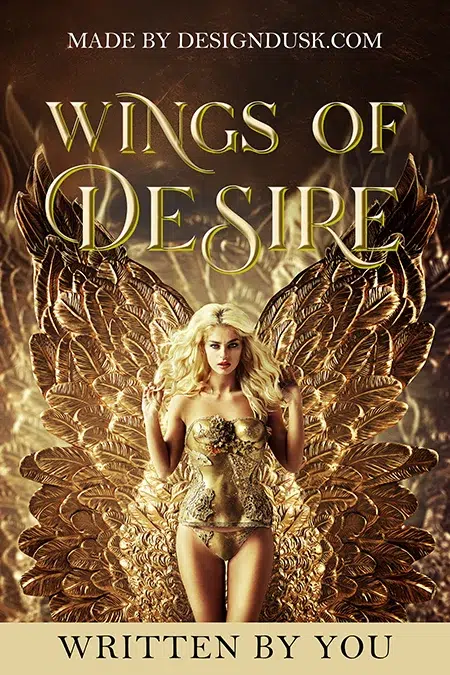
Wings of Desire
Wings of Desire runs the ornament code to its limit: the gilded wings are the whole composition, and the monochrome gold treatment makes the frame feel like an artefact rather than a scene. This one is from our labelled AI-assisted tier at $24.99, which is the honest budget route into a fully ornamented look.
6. Typography: the romance lives in the letterforms
Our fantasy guide covers the fantasy type codes, so here is the romance half. High-contrast serifs (thick strokes against hairlines) are the genre default because they read as both elegant and sharp. Ornamented capitals, ligature flourishes and gold or foil-look fills all push the romance side harder. What kills a romantasy cover fastest is thriller type: a heavy geometric sans over these images reads as urban fantasy and mis-sells the book. If you must choose one signal to spend money on, spend it here; type is the first thing a browsing reader processes at thumbnail size.
Where romantasy stops
Two borders matter, because crossing either one accidentally costs you readers.
| Border | The signal that crosses it |
|---|---|
| Paranormal romance | The love interest’s creature nature leads: wolves, fangs, glowing eyes. Contemporary-world clothing instead of court dress. See our paranormal romance cover guide and shelf. |
| Dark romance | Black field, single red accent, symbolic menace (thorns, masks, daggers). Covered fully in our dark romance covers article, and the shelf lives at dark romance. |
If your book is secondary-world with a central love story, stay in the codes above. If the romance happens in this world with supernatural creatures, you want paranormal codes instead.
Buying the cover
Every cover in this article is in stock today and sold exactly once, so nobody else’s romantasy wears your design. Designer-created premades are $49.99 for the ebook cover, $99.99 with the print paperback wrap, $149.99 with hardback. The labelled AI-assisted tier is $24.99 / $59.99 / $99.99. If your story needs a specific pairing of signals the shelf does not hold (a particular creature, a named object, series-matched sets), custom design runs $120 to $350, and our premade versus custom guide walks the decision honestly.
FAQ
— Browse the crossover in both directions: 245 fantasy covers and 280 romance covers in stock, each sold once. From $24.99.
At minimum: one fantasy worldbuilding signal (crown, armour, magic effect, secondary-world costume) and one romance signal (a charged couple pose, a longing figure, or a romantic object such as a rose). High-contrast serif type ties them together. A cover with only the fantasy half sells as straight fantasy and misses romance readers.
Jewel tones dominate: emerald, sapphire, amethyst and deep rose, often with gold or silver type. Common builds are a warm/cold split that maps the couple onto colour temperature, a purple-pink night sky, and a cold monochrome frame with one warm object. Desaturated grey palettes read as grimdark and mis-sell the romance.
Romantasy is set in a secondary world (courts, kingdoms, invented magic) with the romance central to the plot. Paranormal romance is set in our world with supernatural love interests: shifters, vampires, fae crossing over. On covers, romantasy shows crowns and armour; paranormal shows the creature, contemporary clothing and moonlight.
Our designer-created premades are $49.99 for the ebook cover, $99.99 with a print paperback wrap, and $149.99 with hardback. The labelled AI-assisted tier starts at $24.99. Custom romantasy design, useful for series sets or specific scenes, runs $120 for ebook to $350 for hardback. Every premade is sold once and retired.