
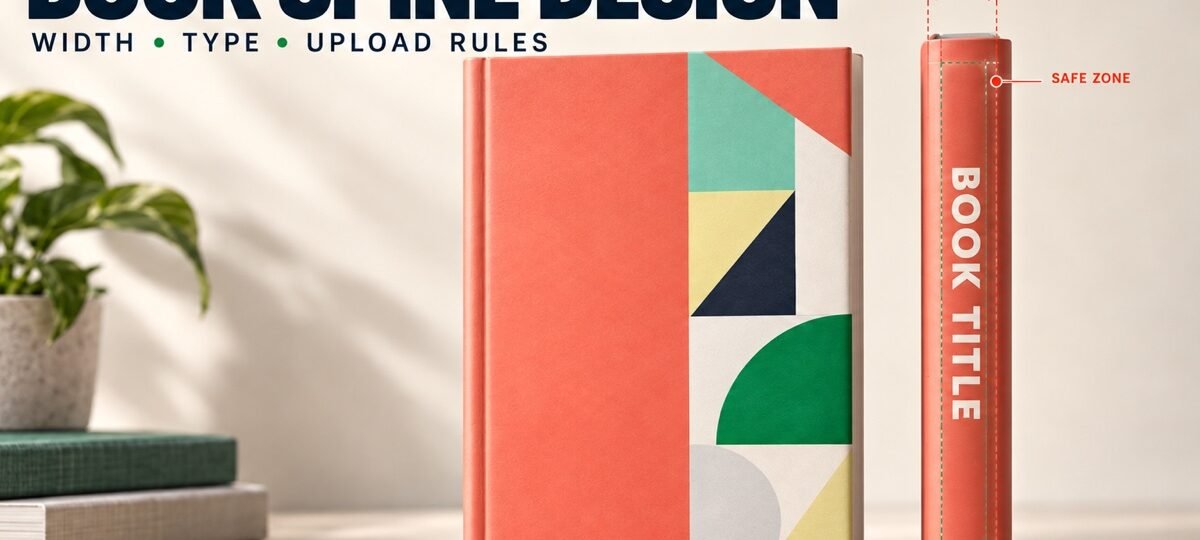
Quick answer
Spine width is page count multiplied by paper thickness: 0.002252 in per page on KDP white paper, 0.0025 in on cream. Spine text runs top to bottom in the US and UK convention and needs 0.0625 in of clearance from each fold. KDP books below 80 pages should carry a blank spine.
The spine is the panel most self-publishers design last and the panel that causes the most upload failures. It is also the only part of your book a browser sees on a physical shelf. We build print wraps for KDP and IngramSpark every week, and the same three spine mistakes account for nearly every rejection we get asked to rescue. This guide covers the width maths, the text direction convention and those three rules using the platforms’ current specifications.
The fantasy shelves hold 245 in-stock covers as of this update, 37 of them epic fantasy. Every design is sold once and retired. Designer-Created premades run $49.99 for the ebook cover and $99.99 with the paperback wrap; labelled AI + Human designs run $24.99 and $59.99.
[SVG DIAGRAM: i025-book-spine-design-self-publishing-diagram.svg, the full paperback wrap with the spine panel, clearance guides and the width formula]
What is the spine of a book?
The spine of a book is the bound edge that faces out when the book stands on a shelf. On a print cover file it is the middle panel of one continuous wrap: back cover, spine, front cover, printed as a single sheet and folded twice. There is no separate spine file. If you have only ever published ebooks, this is the jump: an ebook cover is one flat front image, while a print cover is a wrap whose middle panel must be exactly as wide as your book block is thick.
That word “exactly” is the whole subject. The printer folds at fixed positions calculated from your book’s specs. If your spine panel is wider or narrower than the real book block, the folds land inside your artwork and the spine text drifts onto the front or back panel. The full template geometry, trim sizes included, lives in our book cover size guide; this article stays on the spine itself.
How wide is a book spine?
Spine width is a multiplication, not a measurement: page count times the thickness of one sheet of the paper you chose. KDP publishes per-page thicknesses for black-ink books: 0.002252 in per page on white paper and 0.0025 in on cream. Colour books use their own values: premium colour is 0.002347 in per page and standard colour is 0.002252 in per page. Cream is the thicker stock, which surprises people: the same novel gains about a tenth of an inch of spine just by switching from white to cream at 300 pages.
Here is the table we work from for KDP black-ink paperbacks:
| Page count | White paper (0.002252 in/page) | Cream paper (0.0025 in/page) |
|---|---|---|
| 100 | 0.23 in | 0.25 in |
| 150 | 0.34 in | 0.38 in |
| 200 | 0.45 in | 0.50 in |
| 250 | 0.56 in | 0.63 in |
| 300 | 0.68 in | 0.75 in |
| 350 | 0.79 in | 0.88 in |
| 400 | 0.90 in | 1.00 in |
| 500 | 1.13 in | 1.25 in |
All figures follow from the KDP multipliers above. IngramSpark runs different paper stocks with different thicknesses, and you never do this arithmetic yourself there: its Cover Template Generator emails a custom template and supporting files for your exact specification. The practical rule for both printers: run the official calculator for your exact spec, never reuse a spine width from an old book or a tutorial screenshot.
One more thing the formula tells you: the maths only works with your final page count. A manuscript that is still being edited or formatted does not have a spine width yet. If your interior is not locked, format it first; our interior formatting service runs $95 to $395 and hands back the exact page count the wrap needs.
Which way should book spine text run?
In the US and UK convention, spine text runs top to bottom: rotate the title 90 degrees clockwise, so it reads left to right when the book lies face up on a table. That face-up test is the memory trick. Most of continental Europe runs the other way, bottom to top, which is why imported paperbacks look upside down on a mixed shelf. For a book sold through Amazon, KDP or IngramSpark to English-speaking markets, top to bottom is the answer.
Two refinements from shelf practice. Books with spines around an inch or more can carry horizontally stacked text instead, one word per line reading normally, which is the look trad publishers use on thick hardbacks. And series books usually put the series number at the foot of the spine, small and consistent across the set, because that is where a reader’s finger checks order on a shelf.
The 3 rules that break uploads
Rule 1: the 0.0625 in clearance. KDP requires spine text to sit at least 0.0625 in inside each fold. This exists because binding drifts a little from copy to copy, and it is the rejection self-publishers report most in KDP groups. It quietly shrinks your canvas: a 220-page book on white paper has a 0.50 in spine, but only the middle 0.37 in band can carry text. Set your spine type height from the usable band, not the full width. If the previewer still flags the file, work through our KDP cover rejection checklist.
Rule 2: the minimum page count. Below a printer-specific threshold the spine is too narrow for text at all. KDP allows spine text only on books with more than 79 pages. IngramSpark’s current file guide says books below 48 pages cannot carry spine text; for thicker books it specifies a 0.0625 in safety area when the spine is at least 0.35 in wide and about 0.03125 in on thinner spines. If your book is short, design a blank spine on purpose: carry the background colour across and let the front cover talk. Poetry collections and novellas live here, and a clean blank spine looks far better than 6 pt text nobody can read.
Rule 3: the guessed page count. The most expensive mistake is not a wrong number, it is a right number from the wrong moment. A wrap built while the interior was still moving is invalid the day the final proofread cuts twelve pages. Lock the interior, then build the wrap. When we sell a premade, the $49.99 ebook front can ship immediately, and the paperback-tier wrap gets built once you confirm final page count and paper for exactly this reason.
Designing a book spine that sells on a shelf
A spine is a cover at one-tenth width, so the design rules are thumbnail rules made stricter: one colour for the title, high contrast against the background, condensed or tall type, no thin scripts. Test yours by scaling the spine panel to actual size on screen and stepping back a metre. If the title band on your front cover only works large, the spine will fight you.
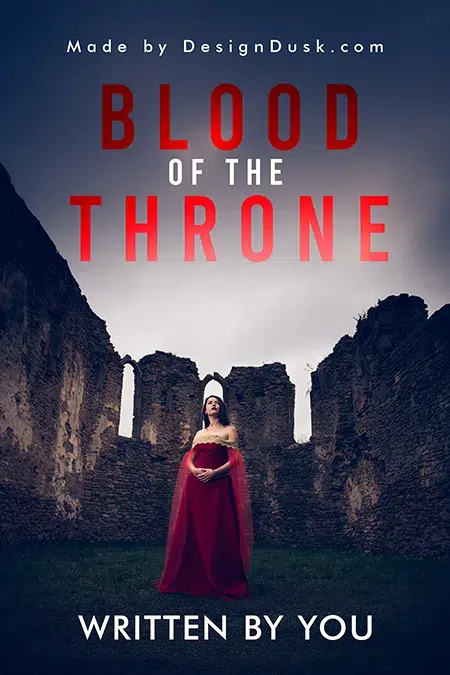
Blood of the Throne
This is what a spine-friendly title treatment looks like on a front cover. Blood of the Throne sets tall condensed capitals in one saturated red against a flat desaturated field, and that exact combination survives being squeezed into a 0.8 in strip. Designer-Created tier: $49.99 for the ebook cover, $99.99 with the full paperback wrap, spine built to your final page count.
Browse the epic fantasy shelf for more long-book covers with heavy title type, or the full fantasy shelf. For spines that need more than type on colour, a jacketed hardback, stacked series branding, printed-case wrap art, that is a custom project, $120 to $350 depending on format.
FAQ
Multiply your final page count by the per-page thickness of your paper. On KDP black-ink paperbacks that is 0.002252 in per page for white paper and 0.0025 in for cream, so a 300-page cream book gets a 0.75 in spine. IngramSpark supplies the width inside its emailed cover template instead.
Top to bottom in the US and UK convention: rotate the title 90 degrees clockwise so it reads left to right when the book lies face up. Most of continental Europe runs bottom to top, but for books sold through Amazon or IngramSpark to English-speaking markets, top to bottom is standard.
KDP requires more than 79 pages, meaning 80 pages or more. IngramSpark’s current file guide says books below 48 pages cannot carry spine text. Shorter books should use a deliberate blank spine with the background carried across the fold.
Almost always one of three causes: spine text closer than 0.0625 in to a fold, a spine width calculated from the wrong page count or paper stock, or spine text on a book too thin to carry it. Rebuild the wrap on the printer’s current template for your exact final specs and re-upload.