
Quick answer
Travel writing splits into three products with three cover logics. Travel memoirs sell feeling: a lone figure inside a big landscape. Guidebooks sell utility: bold type, a recognisable landmark, a repeatable series layout. Photo-led travel books sell the image itself: full-bleed photography with minimal type. Pick your book’s type first, then design.
“Travel book” covers three different products that happen to share a shelf, and each sells to a different buyer. Design the wrong cover for your type and the right reader scrolls past. This guide separates the three logics and shows each on real in-stock covers, so you can place your own manuscript before you spend a dollar on design.
Our travel shelf holds 33 designs in stock as of this update. Every cover is sold once, then retired. Designer-created covers run $49.99 ebook, $99.99 with paperback, $149.99 with hardback; the shelf’s AI-assisted covers, always labelled as such, start at $24.99.
Which travel book are you writing?
| Travel memoir | Guidebook | Photo-led travel book | |
|---|---|---|---|
| The buyer wants | A transformation story | A trip planned | A place to look at |
| The cover sells | Feeling and atmosphere | Trust and utility | The photograph itself |
| Dominant element | Figure in a landscape | Type and landmark | Full-bleed image |
| Type treatment | Evocative, part of the scene | Big, systematic, consistent | Minimal, out of the way |
| Series pressure | Low | High: volumes must match | Medium |
The rest of this guide takes each column in turn.
Travel memoir covers: the figure in the landscape
A travel memoir is a memoir first. The reader is buying who you became out there, so the cover borrows memoir’s strongest move: one person, usually seen from behind, inside a landscape that dwarfs them. The full logic of that device lives in our memoir cover design guide; here is how it plays out with a passport in its pocket.
Breathe, Wander, Repeat
Breathe, Wander, Repeat gives two thirds of the frame to empty blue sky and lets one small figure, arms spread on a white sandbar, carry all the emotion. The title sits in the sky in clean white capitals, so the type never fights the horizon. This is the freedom-and-reset register that escape memoirs sell, and it reads perfectly at thumbnail size.

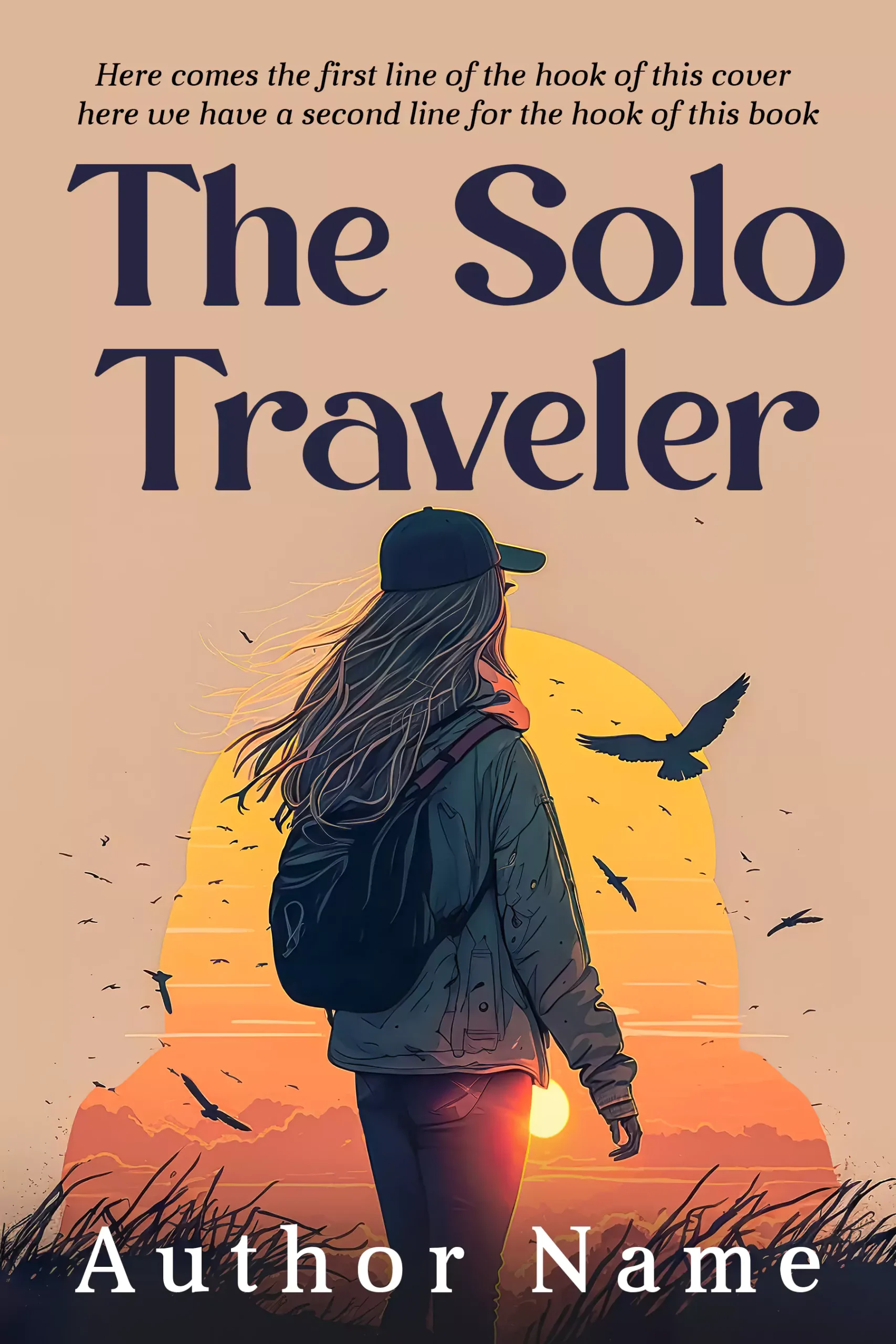
The Solo Traveler
The Solo Traveler makes the same move in illustration: a backpacked figure from behind, walking into an enormous orange sun. Illustration softens the promise from “this happened” to “this could be you”, which suits reflective journey memoirs, and the chunky navy serif keeps the title grounded while the sky glows. A drawn cover also sidesteps the need for a professional photo shoot.
Tales from the Trail
Tales from the Trail runs on scale: a mirrored snow peak fills the cover while the hikers on the shoreline are barely a millimetre tall. The thin dark-red capitals stretched across the mountain add tension to an otherwise serene photograph. Hiking and expedition memoirs live on this person-to-landscape ratio, because the imbalance is the story.

Travel memoirs also sit on our memoir and biography shelf, and it is worth walking both shelves before choosing: the strongest figure-in-landscape designs move between them.
Guidebook covers: utility you can spot across a shop
Nobody buys a guidebook for atmosphere. They buy it to not get lost, so the cover’s job is instant recognition and trust. The big series players lock a type system, a colour block and a layout, then repeat it for hundreds of destinations; the destination image changes, the brand never does. A self-published guidebook cannot borrow their trade dress, but it can borrow the logic.
The working rules: the destination name is the hero, set larger than everything else. One instantly recognisable image, a landmark, a map, or a clean destination photo, sits behind or beside it. And if you plan more than one guide, design volume one as a template, because series consistency is the whole game.
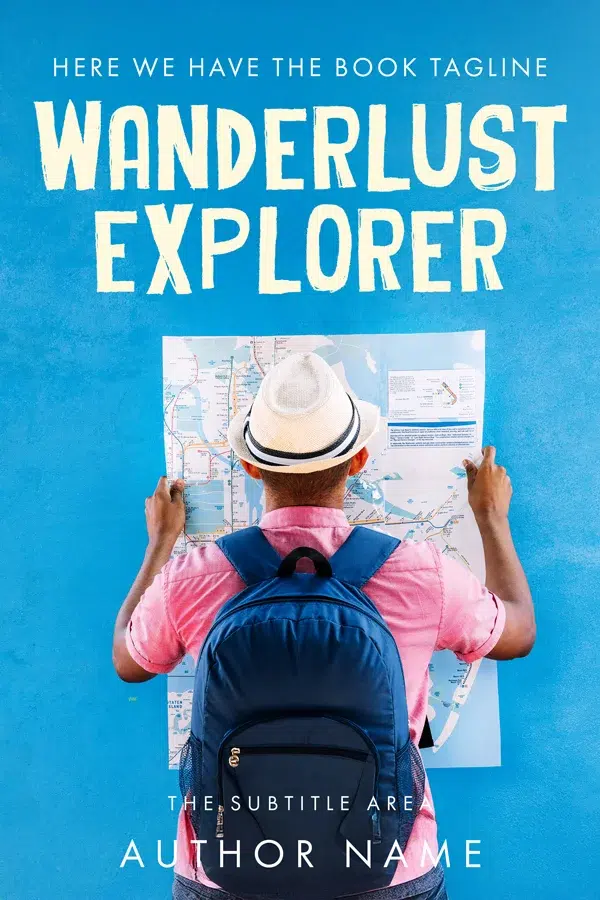
Wanderlust Explorer
Wanderlust Explorer shows the buyer their own near future: a traveller holding a huge unfolded map against a flat blue wall. The map is the promise of the product, and the hand-drawn cream capitals keep the energy casual rather than corporate. A photographic cover like this suits city guides aimed at younger independent travellers.
Wanderlust Diaries
Wanderlust Diaries goes fully graphic: passport, boarding passes, camera, postcards and a folded world map in flat retro coral-and-cream vectors on charcoal. Icon systems like this scale beautifully across a series, because you can swap the icon set per destination while the grid stays fixed. This one is from our AI-assisted tier, labelled as such, at $24.99.
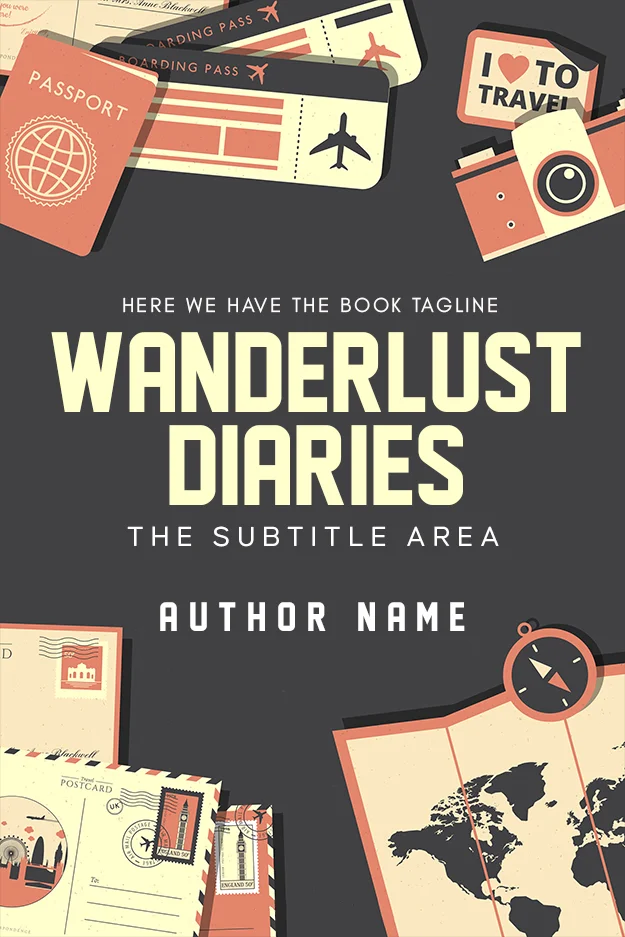
Photo-led travel books: get out of the picture’s way
Coffee-table and photography-led travel books invert the guidebook rule: the image is the product, so the cover is your single best photograph at full bleed with the type nearly silent. Small capitals, generous letterspacing, one line, usually white. The mistake we see most is decorating a strong photograph until it becomes a weak poster.
Print quality carries more weight here than in any other travel format: a photo book sells in hardback, bleeds matter, and spine width shifts with page count. Our book cover size guide covers the wrap mechanics before you commit a layout.
The shared toolkit: maps, landmarks, luggage
Three motifs recur across all three travel formats because readers decode them instantly.
The Timeless Atlas
The Timeless Atlas is the map motif at its most restrained: a terracotta world map ghosted into aged parchment, deep red letterspaced serifs above. No figure, no landmark, just cartography as texture. Covers like this suit travel essays, history-of-travel titles and anthologies, where naming one destination would narrow the book.

Suitcase of Dreams
Suitcase of Dreams stacks the entire genre into one composite: a sticker-covered vintage suitcase with Big Ben, the Statue of Liberty, the Eiffel Tower and half a dozen other landmarks growing out of it. It is deliberately maximalist, the bucket-list promise made literal, and the red retro script leans into the nostalgia. Round-the-world narratives and gift books can carry this much; a single-city guide cannot.

Use the motifs with intent: maps signal reflection, landmarks signal itinerary, luggage signals departure. Mixing all three usually signals indecision.
An honest note on our shelf, and when to go custom
Just over 30 in-stock travel designs is a real range for memoirs and general travel narratives, and every one is sold exactly once. It is not deep enough to cover every destination-specific guidebook, and a guidebook series needs a locked template no premade shelf can promise. That is custom work: custom design runs $120 for ebook, $250 for paperback and $350 for hardback, and a series template is exactly the kind of brief it exists for.
FAQ
It matches the cover to the product. Travel memoirs need one figure inside a large landscape and evocative type. Guidebooks need the destination name set huge, a recognisable landmark or map, and a layout that can repeat across a series. Photo-led books need one excellent full-bleed photograph with minimal type. The common failure is designing a memoir cover for a guidebook.
Both work; they position differently. A clean destination photo reads mainstream and trustworthy, which suits comprehensive guides. Flat illustration and icon systems read independent and curated, suit niche guides, and scale more easily across a series because you swap icons rather than reshooting. Whichever you choose, the destination name stays the largest element on the cover.
Sky and sea blues with a warm accent dominate the genre because they read as horizon at a glance. Escape narratives run turquoise and white, adventure memoirs run sunset amber and orange, heritage and history titles run parchment cream with terracotta and deep red. Guidebooks can use any palette if it stays consistent across the series.
On our shelf, an AI-assisted travel cover, clearly labelled as such, starts at $24.99, and designer-created premades cost $49.99 for ebook, $99.99 with paperback wrap, or $149.99 with hardback, each sold only once. Custom travel cover design, including guidebook series templates, runs $120 for ebook, $250 for paperback and $350 for hardback.