Quick answer
A credible business book cover has a short title in confident type, a subtitle carrying the promise, one bold visual idea instead of a stock-photo collage, a restrained palette such as navy and gold, and the author’s credential placed where buyers look. It must read at thumbnail size and across a table.
Business books live a double life. Online they are a thumbnail in an Amazon search; offline they get handed across desks, propped beside conference badges and held up on webinar calls. A novel is judged in a bookstore; a business book is judged in a meeting, usually with its author standing next to it. That is the test the cover has to pass: does it make the person handing it over look more credible or less?
Here are the seven signals we design for, shown on covers from our shelf.
Our business shelf holds 125 covers as of this update, each sold once and retired. Designer-created covers are $49.99 for the ebook file ($99.99 with paperback); the clearly labelled AI-assisted tier starts at $24.99.
1. Pass the conference-table test
Before any design detail, apply the test itself: shrink the cover to 100 pixels and squint, then imagine it lying flat on a table two metres away. In both cases the title should be readable and the cover should look intentional. Business buyers make a fast status judgement, the same one they make about a suit or a pitch deck. Detail-heavy covers fail both distances at once; covers built from one big shape and three or fewer colours pass both.
2. One idea, stated big
The best business covers behave like good logos: one visual idea, stated with total confidence. The genre’s classics are almost embarrassingly simple, and that simplicity is the point, because it signals an author who knows exactly what the book argues.
Leading With Courage
Leading With Courage is one joke told perfectly: a pawn whose shadow is a king. Two colours, one object, a sans-serif title, and the entire thesis of a leadership book delivered before the reader touches it. This is the flat, poster-like style that dominates the front tables of the genre. Designer-created, $49.99.

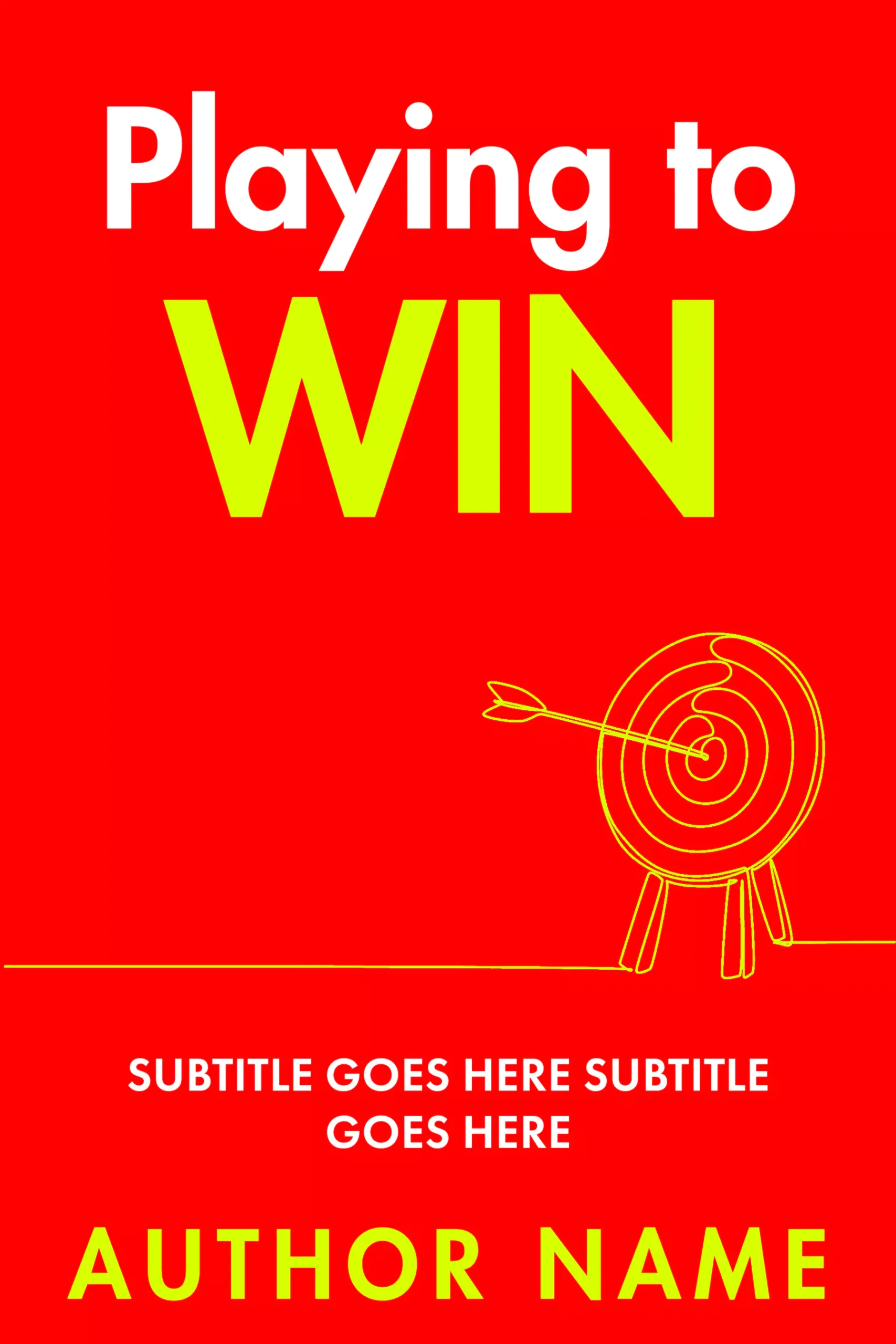
Playing To Win
Playing to Win takes the same discipline further: an unbroken single-line drawing of a target and arrow on a flat red field. It reads instantly at thumbnail size and looks deliberate at any distance. This one is from our AI-assisted tier, labelled as such, which is why it is $24.99 rather than $49.99; the honesty is part of the deal.
3. Typography is the credential
Business readers infer the author’s seriousness from the type before they read a word of the subtitle. Two safe registers exist: an authoritative serif (think finance, strategy, big-idea books) and a clean geometric sans (think startups, product, innovation). Whichever you choose, the title stays short, three or four words, and the subtitle does the heavy lifting underneath in smaller, quieter type. A long title in fancy type is the single fastest way to look self-published in this genre.
The Final Play
The Final Play pairs a moody photograph with a tall gold serif, and the serif is doing half the work: the same image under a rounded sans would read like an airport paperback. Gold type on charcoal is the genre’s shorthand for strategy and stakes. Designer-created, $49.99.

4. Put the credential where buyers look
Buyers of business books are buying the author as much as the argument, so the credential needs a designed home. The conventions: the author’s name sits large at the top or bottom in a stable band; a single credential line rides with it (“Founder of X”, “twenty years leading Y teams”) rather than floating mid-cover; and letters after your name go on the back cover, not the front. If a known name wrote your foreword, “Foreword by” on the front is worth more than any adjective. What the front does not get is a paragraph: one name, one line, done.
5. Use the palette codes buyers already know
Business subgenres have colour dialects. Navy, charcoal and gold signal finance and authority. Red and black signal leadership and provocation. Teal, white and flat illustration signal startup and innovation thinking. These codes are worth obeying because a finance book in startup teal misses its buyer at the shelf. Our shelf leans hard on chess and gold, and we are relaxed about admitting it: the metaphor keeps selling.
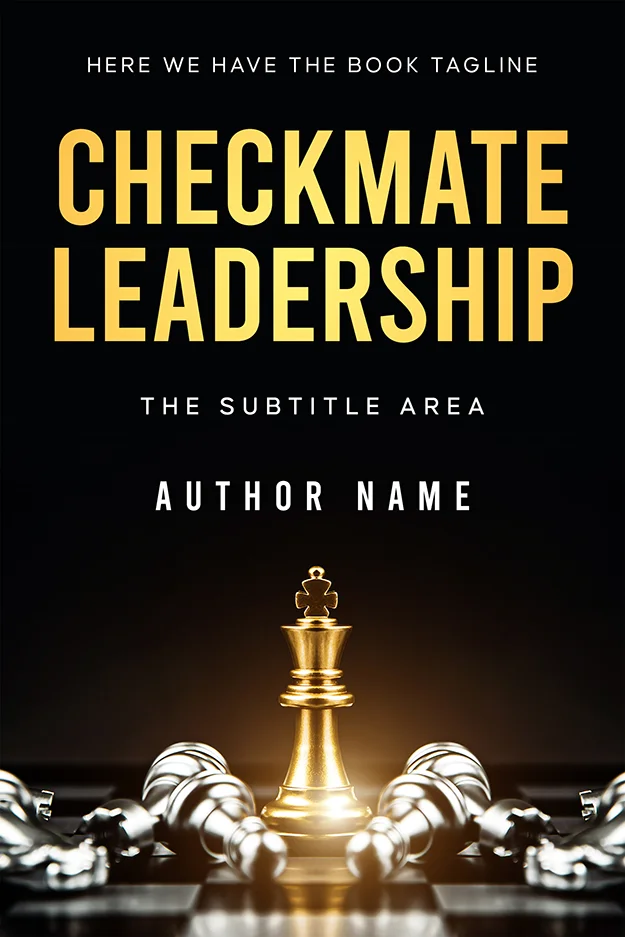
Checkmate Leadership
Checkmate Leadership is the authority palette at full strength: black field, gold king, fallen silver rivals, gold capitals. Subtle it is not, and for a certain kind of leadership book subtle would be wrong; the buyer wants the book to project exactly this much confidence in a meeting. Designer-created, $49.99.
Architect of Ambition
Architect of Ambition softens the same gold-on-light language with a double exposure: the figure and the skyline occupying the same silhouette. Double exposures flatter vision-and-legacy themes, and the white background keeps it airy where Checkmate Leadership goes heavy. Designer-created, $49.99.

6. Wit beats stock photography
The weakest business covers all fail the same way: a literal stock photo (handshake, skyline, climbing figure) with a title stamped on top. If the concept can be drawn with a bit of wit instead, the cover starts a conversation, which is precisely what a book on a conference table is for. This applies double for marketing books, where the cover is itself a work sample; our marketing shelf runs 73 covers deep on exactly that principle.
The Anchor of Reality
The Anchor of Reality illustrates a financial argument, the asset that drags you under, as a tiny man chained to a sinking house. It is funny for exactly one second and then it lands. A concept illustration like this gets picked up and asked about, which no skyline photo ever will. Designer-created, $49.99.

7. Do not forget the spine
Business books get shelved face-in at offices and libraries, and handed around in stacks. The spine needs the title legible in a bold weight, the author’s surname, and enough page count to carry text at all. KDP permits spine text from 79 pages for uploaded wraps, while Cover Creator uses an 80-page minimum; KDP also requires at least 0.0625 inches of space between spine text and each fold. If you are close to the threshold, design the wrap with a clean blank spine instead of squeezing type. The full wrap and spine measurements live in our book cover size guide.
Buying a business cover
Every cover above is on our business shelf, 125 designs as of this update, each sold once and retired, so your book will not share its cover with a competitor’s. Premades run $24.99 (AI-assisted, labelled) to $49.99 (designer-created), with print wraps on every design. If the book needs your framework, your brand colours or your face on it, custom design runs $120 to $350; our cover design cost guide breaks down what each tier buys.
FAQ
Browse the business shelf: 125 covers in stock as of this update, each sold once. From $24.99.
A short title in confident serif or clean sans type, a subtitle carrying the promise, one bold visual idea instead of a stock-photo collage, and a restrained palette of two or three colours. It should stay legible as a 100-pixel thumbnail and look intentional at arm’s length. Simplicity signals confidence, and confidence is the product.
Match the subgenre code. Navy, charcoal and gold read as finance and authority; red and black read as leadership and provocation; teal and white with flat illustration read as startup and innovation. Two or three colours total. White backgrounds photograph well for social media, which matters for books authors promote personally.
Only if your face already sells tickets. Established speakers and consultants gain from a portrait cover because the author is the brand; first-time authors usually lose, because an unknown face displaces the idea. The stronger default is a bold concept on the front, your photo and full bio on the back cover.
Our premade business covers run $24.99 for the clearly labelled AI-assisted tier and $49.99 for designer-created work, with paperback wrap tiers at $59.99 and $99.99. Custom design, including brand-matched colours and full back-cover layout, runs $120 for ebook, $250 for paperback and $350 for hardback. Every premade sells exactly once.