
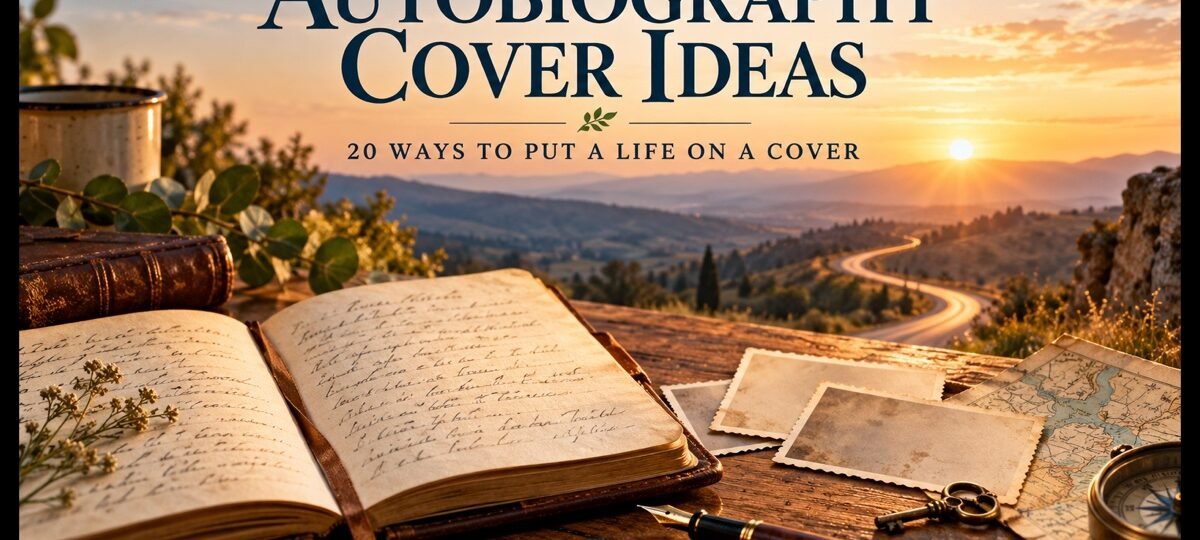
Quick answer
You do not need a professional portrait to put a life on a cover. The strongest autobiography covers use a meaningful place, an object that stands for a person, a figure seen from behind, or era-true typography. Here are 20 ideas, ranked by how well they work without a photo of you.
Most self-publishing autobiographers hit the same wall: no professional portrait, no budget for the shoot. This list is ranked around that reality: the first ideas need no photograph of you at all. In-stock examples from our biography and memoir shelf appear throughout. Writing first-person literary memoir rather than a life story? Start with our memoir cover guide instead.
The biography and memoir shelf holds 52 covers as of this update. Every design is sold once, then retired. Designer-created covers run $49.99 ebook / $99.99 with the paperback wrap; AI-assisted covers elsewhere in the catalogue are always labelled and start at $24.99.
Ideas 1 to 7: no photograph of you required
They need nothing you do not already have, and they routinely outperform mediocre portraits.
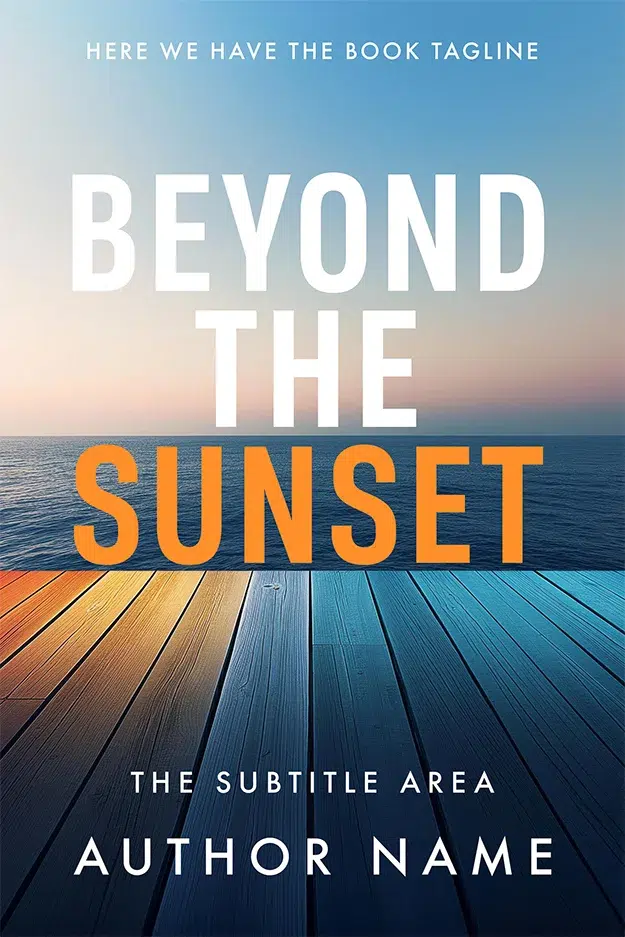
1. The place that made you. A landscape the reader can feel: the coast you grew up on, the mountains you left. Place covers promise a life shaped by somewhere specific; cross-listed designs on our travel shelf show the range.
Beyond the Sunset Book Cover
Weathered deck boards run toward a flat ocean horizon at dusk, white capitals over the sky with one word flipped to orange. No people at all, yet it reads as a life looking back. One warm word on a cool field carries the whole mood. Designer-created, $49.99 ebook.
2. The empty chairs. Furniture that implies people is the strongest people-free device in this genre: the reader fills the empty seat instantly, and the absence becomes the story.
A Row with Two Chairs
Two red Adirondack chairs sit empty on a dock facing a lake and a mountain wall, the title stacked in charcoal and red capitals that echo the chairs. A marriage, a friendship or a loss, all readable in one image.

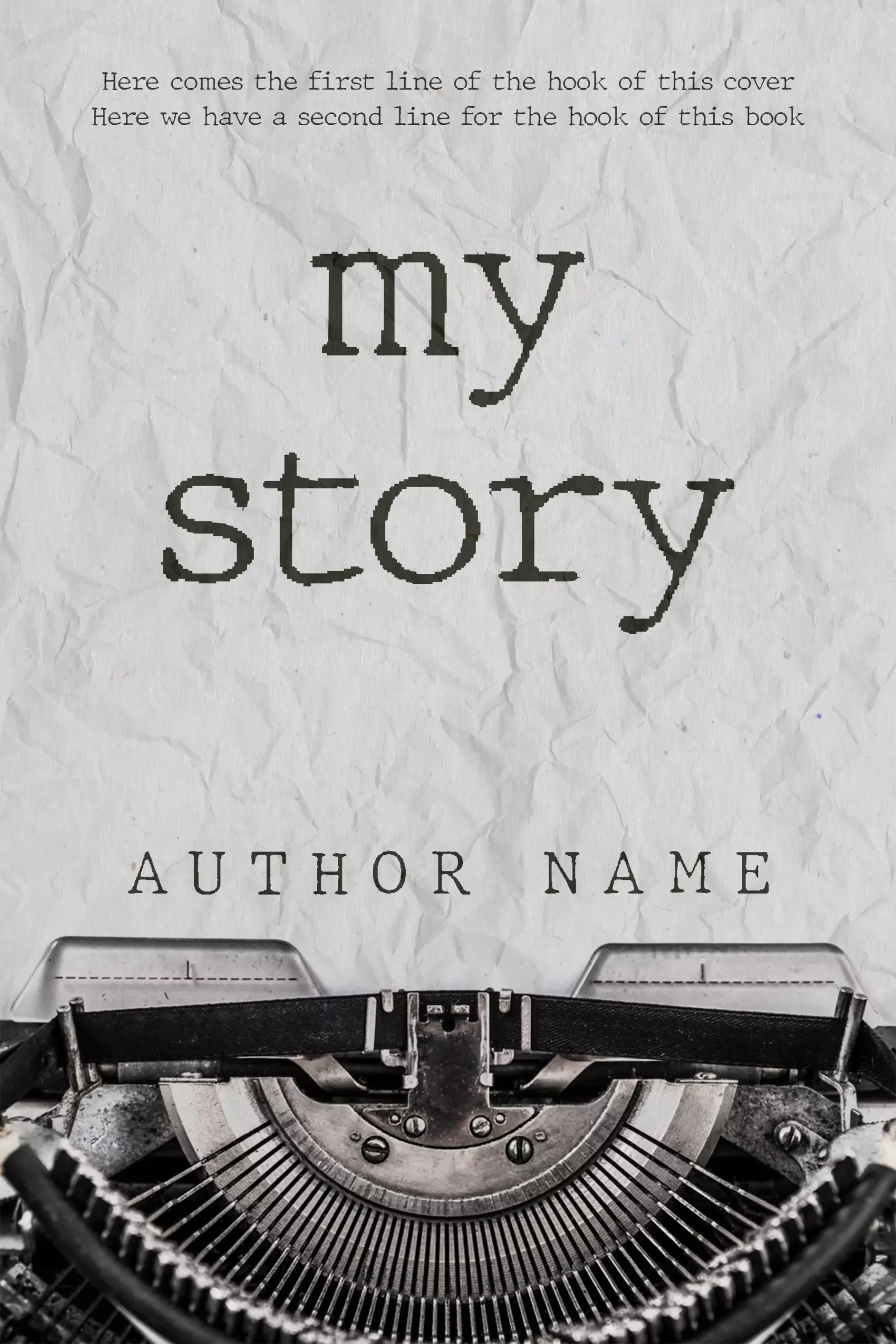
3. The tool of your trade. A typewriter, a scalpel, a fishing net. One object photographed with care tells the reader what kind of life this was.
My Story
Crumpled paper fills the frame, a vintage typewriter photographed along the bottom edge, and the title set small in an actual typewriter face. The texture does the confessional work before you read a word. It suits any story told plainly and without varnish.
4. One symbol on a plain field. A single tree, a key, a pair of boots, centred on white or black. The most minimal idea here, and the one that depends most on the quality of the type.
5. The road or path. A track through hills, a highway at dawn. The oldest metaphor in autobiography still converts: a life as a journey, the destination implied by the light.
6. The season as chapter. Autumn leaves, first frost, spring blossom. Seasonal imagery locates the book emotionally rather than geographically, and it hands the designer a ready-made palette.
7. The hand-drawn scene. When no photo of the defining moment exists, illustration builds it. A drawn scene also softens hard material; illustrated covers carry difficult childhoods better than photography.
Ideas 8 to 12: you appear, face hidden
You appear, the likeness stays private, and no portrait session is needed.
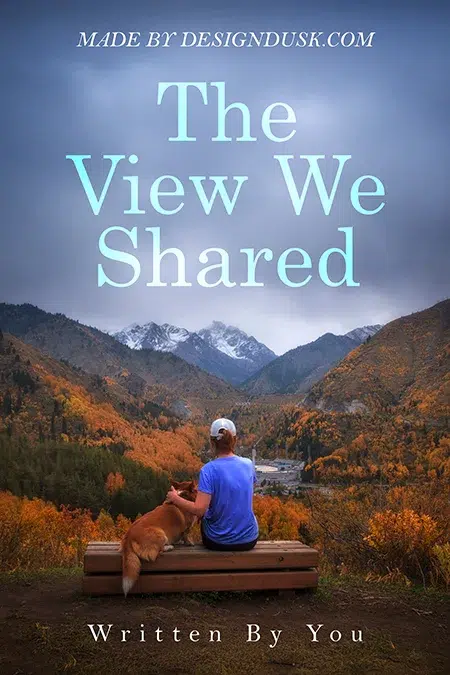
8. The figure from behind. Stand where the story happened and face the view. The reader steps into your position: the exact invitation an autobiography makes.
The View We Shared
A person and a corgi sit on a bench with their backs to us, looking down an autumn valley toward snow-capped peaks, the pale blue serif title set in the cloudy sky. From-behind framing puts you on your own cover without a portrait session. The dog earns more warmth than any tagline could.
9. The silhouette at golden hour. Backlight removes every flaw a self-conscious author worries about and leaves shape and mood. A phone photo at the right hour can supply the raw material.
Moments In Time
A lone silhouette stands at the shoreline under a coral-pink sunset, the title in tall white serif letters across the sky. A silhouette is a portrait with the permissions problem and the bad-photo problem removed. The single-colour wash makes the image read as memory rather than snapshot.

10. In motion, face away. Walking, cycling, mid-stride on a trail. Motion adds the sense of a life still going somewhere and gives the composition a direction for the title to balance against.
11. Hands only. Working hands kneading dough, holding a photograph, resting on a cane. Hands carry age, labour and tenderness more honestly than faces, and nobody ever hated a photo of their hands.
12. The double exposure. A profile filled with the landscape of the life. The most technically demanding idea here; composited well, it says the person and the place are inseparable.
Pathways of Time
The profile of a silver-haired woman is filled with a lake scene: autumn trees, still water and a kayaker mid-paddle, all held in sky blue. The technique literally puts the life inside the person. It is exactly the brief where custom design, $120 to $350, beats template tools.

Ideas 13 to 15: illustrated versions of you
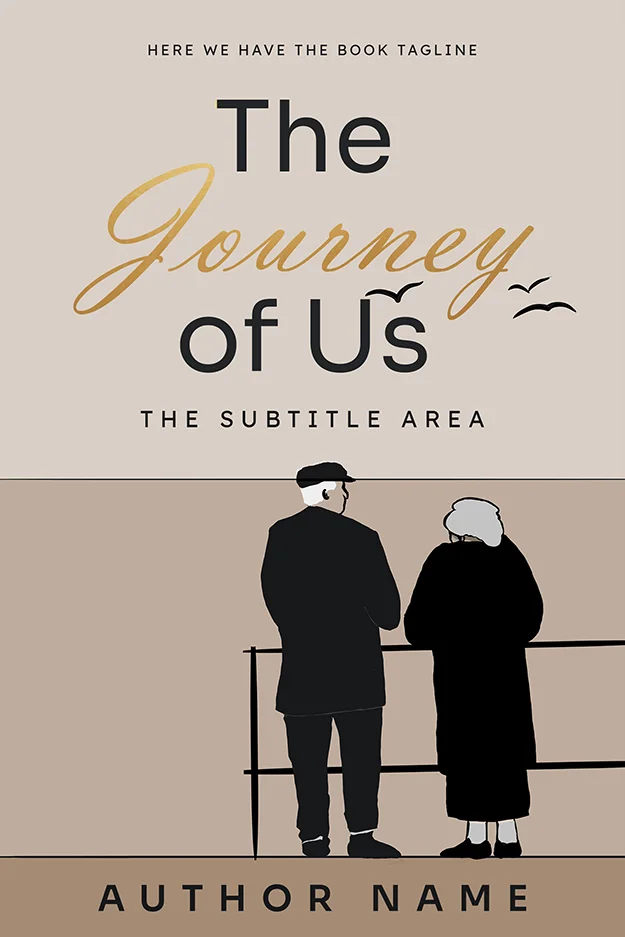
13. The flat vector figure. A simplified illustrated you, no facial features needed. Illustration ages better than photography, needs no likeness clearance, and keeps its charm at thumbnail size.
The Journey of Us
An elderly couple seen from behind at a railing, drawn as flat black shapes on a two-tone taupe ground, with one gold script word set inside a black serif title. The silhouettes withhold the faces; the gold script supplies the warmth.
14. The childhood self. Put the child you were on the cover. A child figure disarms the reader and signals the story starts early.
Reaching for Dreams
A small child reaches up toward a giant coral daisy on a soft peach gradient, the dusty red serif title above. The scale distortion turns a family-album moment into an image no album holds. It fits any life that began with wanting more than the town offered.

15. The painted portrait. A watercolour or oil-style rendering of a real photo. The brushwork adds distance and dignity, and it can rescue a low-resolution source photo that could never print as photography.
Ideas 16 to 18: you have one good photo
16. The direct-gaze studio portrait. Run it big, crop close, and let the eyes do the selling. Black and white hides a multitude of lighting sins and reads instantly as serious nonfiction.
17. The archival snapshot, framed as an artifact. Print the old photo small, give it a torn edge or a tape corner, and surround it with calm typography. The cover becomes an object from the life rather than a picture of it.
18. The candid over the formal. A laughing kitchen-table shot outsells a stiff studio sitting when the book’s voice is warm. Match the photo’s register to the writing’s register.
Ideas 19 and 20: type does the work
19. Handwriting or typewriter type as the whole cover. Your own handwriting, scanned and enlarged, or honest typewriter lettering on paper texture. No image at all, and the intimacy is the design.
20. Title-only typography with one accent. A plain field, a strong typeface, one accent colour used exactly once. The cheapest idea to produce and the hardest to execute; it stands or falls on type discipline. More directions across every genre live in our cover design ideas guide.
Picking one
Rank your assets honestly: a strong place, object or symbol beats a weak portrait every time. If an in-stock design already says what your story says, the biography and memoir shelf starts at $49.99, and each cover retires when bought. A cover that needs building from scratch is custom work, $120 to $350.
FAQ
For more on permissions, likeness, and the conventions that separate life writing from fiction, see our biography book cover design guide.
Browse the biography and memoir shelf: 52 covers in stock, each sold once. From $49.99, custom from $120.
One element that carries the life: a meaningful place, an object tied to your work or family, a figure seen from behind, or a single strong portrait. Set the title in one or two typefaces, keep the palette restrained, and check everything reads at thumbnail size.
Use imagery that implies you instead of showing you: the place that shaped the story, empty chairs, the tool of your trade, a silhouette, a from-behind figure, or an illustrated stand-in. These approaches avoid portrait costs and likeness issues entirely, and they routinely outsell average-quality author photos.
There is no single best colour; the working rule is one restrained base palette plus one accent used exactly once. Warm golden tones read as nostalgia, cool blues and greys read as reflection, and black and white reads as serious documentary. Match the palette to the book’s emotional register.
A premade designer-created cover costs $49.99 for the ebook version or $99.99 with a print wrap, and each design is sold only once. Labelled AI-assisted premades start at $24.99. A custom cover built around your own photos or a specific scene runs $120 to $350 depending on format.